Sunday, 23 November 2014

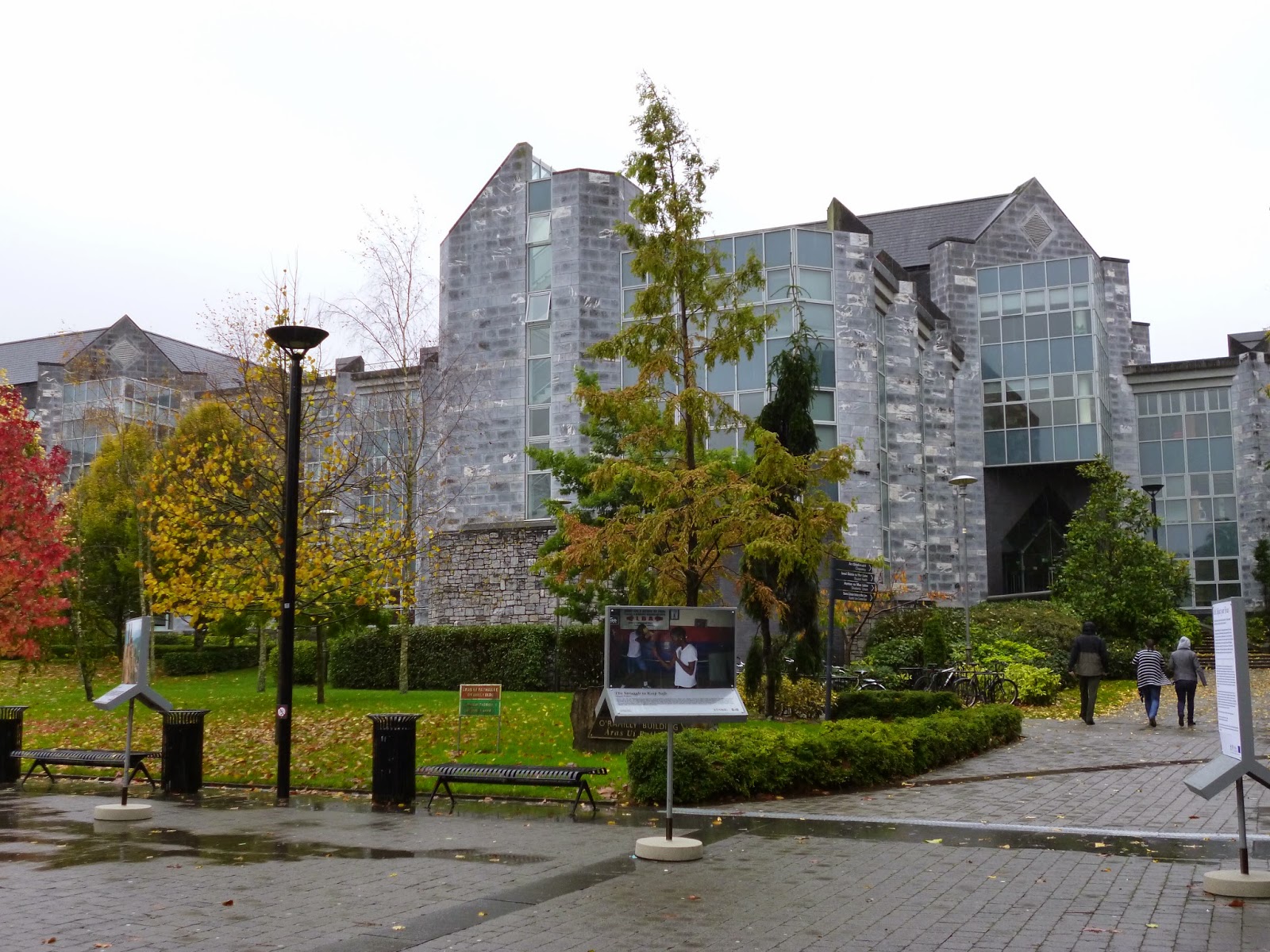
NPHFI 2014 Conference - University College Cork

The 2014 Annual Conference of the Newspaper and Periodical History Forum of Ireland NPHFI took place in University College Cork (UCC) on 21 & 22 November 2014. As Secretary of the Forum, I had a bit of work to do in organising the conference.


The conference was opened by the NPHFI Chairman, Dr Mark O'Brien and delegates were welcomed to UCC by the Head of the UCC School of History, Prof David Ryan. The Chairman of the Irish Examiner newspaper, Mr Tom Crosbie, also welcomed the conference delegates to Cork.

The conference theme was: 'Home thoughts from abroad: History, the Press and Diaspora'. I suppose diaspora is something that Irish people know a great deal about, with generations of Irish having been forced to move abroad in search of work and a better life.

Speakers came from universities in Ireland, UK, USA and Australia to present papers on how the link between Ireland and the Irish around the world was maintained over generations by means of the newspaper and the periodical.

The plenary speech was delivered by Prof. Donal McCracken, University of KwaZulu-Natal, South Africa, who spoke about Irish edited newspaper in South Africa. There's a short piece on the conference on the Evening Echo website here.

Details of the 2015 conference will be announced soon on the NPHFI website http://newspapersperiodicals.org/ and Facebook page https://www.facebook.com/NPHistoryForum

Sunday, 9 November 2014

59th Cork Film Festival - documentary film: 'Séamus Murphy: A Quiet Revolution'

The 59th Cork Film Festival has just started. It runs from the 7th to the 16th of November 2014. I have already attended two screenings and I'd like to write about one of them here.

The title of the documentary film that I saw this morning was: "Séamus Murphy: A Quiet Revolution". It told the story of Cork born sculptor and stone carver Séamus Murphy RHA (1907-1975). The Irish writer and academic, Daniel Corkery was one of Murphy's teachers in school and it was Corkery who gave Murphy his first drawing lessons.

Murphy studied modeling at the Crawford Municipal School Art in Cork on Corkery's advice. He later attended night classes there and won a Gibson Bequest scholarship in 1931. With this scholarship, Murphy went to Paris in 1932-33, but doesn't seem to have enjoyed his time there. According to the documentary, Murphy found that his fellow artists in Paris were more interested in discussing art rather than actually making it.


Crawford Municipal School of Art, Cork (now Crawford Art Gallery), where Séamus Murphy learnt his trade.

Séamus Murphy's work can be seen all over Cork and throughout Ireland. He exhibited at the New York World's Fair in 1939 and was elected as a member of the RHA in 1954. He was commissioned to do sculptures in churches and he also created busts of politicians. However, he also had to do 'ordinary' work to earn a living. He created headstones for graves and this work can be seen in graveyards all over Cork. A list of his major works can be viewed here and a biography can be viewed here.


Bust of Michael Collins by Séamus Murphy in Fitzgerald's Park, Cork.

Watching the documentary, I was reminded of the brilliant RTÉ television series 'Hands', which looked at different traditional Irish crafts. I just want to say well done to the filmmaker for creating such an interesting film about a person I had not heard of before and well done to the Cork Film Festival for showing it.

Saturday, 1 November 2014

An Irishman's Diary - The Irishmen who fought for the pope

Today, Saturday, 1 November 2014 sees the publication of my latest Irishman's Diary article in the Irish Times. It's about the Irishmen who served in the Papal Army in 1860. Numbers vary, but it is generally accepted that at least 1,000 Irishmen made their way to Italy to fight for the pope.

Pope Pius IX blessing his troops in St Peter's Square, Rome before the Capture of Rome, April 1870. Image source: http://commons.wikimedia.org/wiki/File:Pioixblesstroup.jpg

The men were recruited throughout Ireland to defend the pope's temporal authority (in other words the Papal States), which was being threatened by troops of King Victor Emmanuel who wanted to unify Italy.

It sounds strange these days, but from around the 8th century CE, the pope was the ruler of a vast stretch of land in central Italy, known as the Papal States. It ceased to exist in 1870 when Italy was unified. The Risorgimento, which was led by men such as Giuseppe Mazzini, Count Cavour, Giuseppe Garibaldi and Victor Emmanuel, saw Italy transformed from several small states into one Kingdom of Italy.

The Irish and the other papal army volunteers from France, Switzerland, Austria and Belgium were not welcomed by the inhabitants of the Papal States, who saw the men as an invading force supporting a bad government.

It may seem ironic that while some Irishmen were fighting for freedom from Britain at home in Ireland, other Irishmen would go to Italy and support another big power that was oppressing people, but the religious dimension undoubtedly blinded the Irishmen who fought for the pope to what was actually going on. They simply felt justified in fighting for the pope.
Front page of Irish Times newspaper, Saturday 1 November 2014.

FURTHER READING
If you are interested in finding out more about this topic, I would recommend that you have a look at the following sources:

  • G.F.-H. Berkeley, The Irish Battalion in the Papal Army of 1860 (Dublin: Talbot Press, 1929).


  • Robert Doyle, 'The pope's Irish battalion, 1860', History Ireland, Vol. 18, 2010. Available to view here.


  • Ian Kenneally, Courage and Conflict: Forgotten Stories of the Irish at War (Cork: The Collins Press, 2009).


  • Des Ryan, 'The Pope's Emigrants', The Old Limerick Journal, Vol. 39, 2003. Available to view here.

Monday, 20 October 2014

ADEFFI 2014 Annual Conference

The 2014 Annual Association des Études Françaises et Francophones d'Irlande ADEFFI Conference took place in the Long Room Hub in Trinity College, Dublin between 17-19 October 2014.


The conference theme this year was Origines / Origins. Almost fifty speakers came from all over Europe and North America, as well as Australia and South Africa, to present papers on their own areas of research.

They drew on a diverse range of genres and sciences such as literature, film, philosophy, anthropology, poetry and history, to discuss origines / origins. As usual, attendees included a mix of established academics and researchers and some PhD students or newly appointed lecturers.

The guest of honour at the conference was the French novelist, Anne-Marie Garat, who won the Prix Femina for her 1992 novel, Aden.

Next year's conference will take place in the University of Limerick. Keep an eye on the Association's website www.adeffi.ie and Facebook page www.facebook.com/adeffi for more information.

Friday, 5 September 2014

Book Review - Irish Studies Review

My review of the book Nation/Nazione: Irish Nationalism & The Italian Risorgimento (Dublin: UCD Press, 2013) has just been published on the website of the journal Irish Studies Review. Here is the DOI: 10.1080/09670882.2014.955952


It was refreshing to look at a book based on Italo-Irish relations, rather than Franco-Irish studies, which I normally work on. It seems to me that Ireland's relationship with France is quite different from that with Italy.

We've seen that at crucial moments throughout Irish history, Irish people have looked to France for help. An example of this would be the 1798 Rebellion, when Wolfe Tone and The Society of United Irishmen sought and received French military assistance to stage an uprising against British rule in Ireland. I don't think we could say that the same kind of relationship exists / existed between Italy and Ireland.

Nevertheless, there have been a good number of significant cultural, religious and military connections between Ireland and Italy down through the years. For example, James Caulfeild, 1st Earl of Charlemont, who built the architectural gem that is the Casino at Marino in Dublin, traveled extensively in Italy. He spoke the language like a local, admired the country immensely and was greatly inspired by its architecture and customs.

The following book, Italian presence in Ireland: a contribution to Irish-Italian relations (Dublin: Istituto Italiano di Cultura, 1964), would provide readers with an introduction to the area. It was published to mark the 10th anniversary of the founding of the Italian Institute of Culture in Dublin. 

According to an article in the Irish Independent from 8 January 1955, five hundred people applied for membership of the Institute in the first few weeks after it opened. They were only expecting one hundred and fifty. It seems that Irish interest in Italy is nothing new!

Tuesday, 2 September 2014

Dorothea Lange in Ireland - 60 years ago

The American photographer, Dorothea Lange (1895-1965), is perhaps best known for her poignant photographs of migrant families and farm workers in 1930s America. She captured the faces of migrants who had traveled to California from the Midwest of America in search of work and a better life.

This photograph of Florence Owens Thompson surrounded by some of her children was taken at a camp for migrant farm workers in Nipomo, California in 1936.


Image source: http://loc.gov/pictures/resource/fsa.8b29516/

Lange's first trip outside of the USA was to Ireland. In 1954 Dorothea Lange traveled to Ireland on assignment with Life Magazine with her journalist son Daniel Dixon (1925-2009).

While they spent some time in Dublin initially, they were in County Clare for the majority of the one month that they spent in Ireland. Over the course of their stay, Lange took some 2,400 photographs, which are now held in the Dorothea Lange Collection at the Oakland Museum of California. These photos can be viewed online at the University of California's calisphere website.

A nine page article entitled Irish Country People was published in Life Magazine on 21 March 1955. It contains twenty one of Lange's photographs together with a brief sketch by her son detailing the scenes they witnessed.

A book, Dorothea Lange's Ireland was published in 1996. It contains 106 photographs that she took in Ireland as well as articles by academic, Gerry Mullins and her son, Daniel Dixon. Lange's trip to Ireland was also the subject of a film. In Dierdre Lynch's Photos to Send, Lynch travels to Ireland and interviews the surviving subjects of Lange's photographs.

Read more about Lange's time in Ireland on the Clare County Library Blog.

Monday, 26 May 2014

AFIS Conference 2014 in Irish National Concert Hall

The 2014 annual conference for the Association of Franco-Irish Studies (AFIS) took place at the National Concert Hall, Dublin on the 23rd and 24th of May. Appropriately, given the venue, the conference theme was "France and Ireland: Celebrating Music, Words and Art".


The conference was opened by the new French Ambassador to Ireland, Mr Jean-Pierre Thébault. Speakers came from universities all over Europe and North America (including Ireland, France, Germany, Macedonia, UK, USA and Canada). Conference programme available here: http://arrow.dit.ie/afis/programme.pdf

Keynote speeches were delivered by the Irish Times Paris correspondent, Lara Marlowe and the Irish poet and author, Mary O'Donnell.

On Friday 23rd May, Lara Marlowe discussed France's place in the European Union from being firm advocates at the beginning of the project in the 1950s to the present state of the relationship. On Saturday 24th May, Mary O'Donnell was interviewed about her books of fiction and poetry by Sean Rocks of RTE's Arena arts programme. I had heard Mary O'Donnell on the radio before. She presented a really good programme on poetry in translation called Crossing the Lines. I'd advise you to listen to it if you have the time.

I delivered a paper on an aspect of my current research. In my paper, I looked at the way in which the French newspaper Libération used photographs to report on the Northern Irish 'Troubles' in the period from the 1970s to the 1990s.