Tuesday, 19 July 2016

Irishman's Diary - Kenelm Lee Guinness

I have just written a new Irishman's Diary in today's Irish Times newspaper. It's about the award-winning racing driver and automotive engineer, Kenelm (Bill) Lee Guinness (1887-1937). Here is a link to the article.
This is a photograph of Kenelm Lee Guinness driving a Sunbeam, accompanied by his mechanic, Bill Perkins. Image source: Gallica, BnF

Monday, 4 July 2016

Michelin Guide to the British Isles 1911 - Irishman's Diary

I have just written an Irishman's Diary in today's Irish Times newspaper about one of the earliest guides for motorists in Ireland. The Michelin Guide to the British Isles was first published in 1911.

Photograph of 'Bibendum': Michelin's mascot, aka 'The Michelin Man'. Image Source.

The guide, while it looks relatively basic by today's standards, contained information on relevant facilities in towns and villages all over Ireland, as well as some information on car maintenance. Read my article here.

Wednesday, 18 May 2016

Edwin Lawrence Godkin - An Irishman's Diary

Edwin Lawrence Godkin (1831-1902) was a journalist and editor, who wasn't afraid to take on vested interests and fight for a better kind of journalism. Born in Ireland, most of his life was spent in America. 
Caricuture of EL Godkin from 1898. Source: Wikimedia Commons.

Today, Godkin is perhaps best know as the founding editor of The Nation, a liberal, weekly US magazine. He was editor of The Nation from its launch in 1865 until his retirement in 1899. In that time, he took on vested interests and several forms of political corruption, such as Tammany Hall and Boss Tweed. He also opposed US territorial expansion and advocated for US currency reform and civil service reform. 

Read about his life in my Irishman's Diary in the Irish Times newspaper.

Sunday, 24 April 2016

French Newspaper Cartoons - Ireland's Easter Rising

Ireland's Easter Rising was reported in the French press through the form of articles, photographs and even some editorial / political cartoons. Editorial cartoons have long been a regular feature of many popular French newspapers.

Here, we can see cartoons on the front pages of Le Matin from 1 May 1916 and from Le Petit Journal from 27 April 1916 and 5 May 1916. In the first cartoon we can see what appears to be a soldier complete with German style military helmet with a sword marked 'Dublin'. The caption reads 'un coup d'épée dans l'eau'. This is an idiomatic expression that means - a complete waste of time.

The second cartoon shows the Kaiser and suggests that there is an error in a newspaper report relating to the Rising and the landing of German arms in Ireland. Should it not read that the Germans were repelled from Ireland, they wonder. The last cartoon again refers to the German army and shows a soldier (or possibly Kaiser Wilhelm) being attacked by Asquith's project.

Le Petit Journal was one of the main four dailies in France during the first half of the 20th century. It was a conservative newspaper that sold around 2 million copies at the beginning of the 20th century. Le Matin was one of France's main dailies between the 1910s and 1920s, selling around 1 million copies in 1914.
Le Matin, 1 May 1916. Source: Gallica, BnF.
Le Petit Journal, 27 April 1916. Source: Gallica, BnF.
Le Petit Journal, 5 May 1916. Source: Gallica, BnF.

Ireland's Easter Rising in France's Le Monde illustré

Le Monde illustré was the leading French illustrated weekly news magazine of the late 19th and early 20th century. It began publication in 1857 and was similar in style to The Illustrated London News, which was the world's first illustrated news magazine. By 1916, Le Monde illustré ran to 14 pages and cost 60 centimes. The format normally consisted of a mix of full page illustrations, a selection of several different illustrations grouped together and text articles.

Ireland's Easter Rising was covered on several occasions in the news magazine, beginning on 6 May 1916 and again on the following two weeks, 13 May 1916, 20 May 1916. In much of the French press at the time, the rising was portrayed simply as a German inspired plot to attack France's ally, Great Britain, and not as a push for Irish independence. The Germans are mentioned frequently in the coverage and Roger Casement, the man who uncovered large scale human rights abuses in the Belgian Congo, was labeled a traitor.
Le Monde illustré, 6 May 1916. Source: Gallica BnF.
Le Monde illustré, 13 May 1916. Source: Gallica BnF.
Le Monde illustré, 20 May 1916. Source Gallica BnF.

Gallica is the digital library of the Bibliothèque nationale de France [French National Library]. It contains a wealth of material including books, newspapers, magazines, photographs, letters, manuscripts and sound recordings. Here, you can search 58 years of Le Monde illustré - http://gallica.bnf.fr/ark:/12148/cb32818319d/date

Monday, 4 April 2016

Susan Langstaff Mitchell - An Irishman's Diary

Today, a new Irishman's Diary by me appears in the Irish Times newspaper. It is about the poet, journalist and editor, Susan Langstaff Mitchell (1866-1926). Born in Carrick-on-Shannon, County Leitrim, Mitchell played a part in the Irish Literary Revival at the turn of the 20th century. Read it here.

Below is a copy of the front page of the Irish Homestead of 9 January 1904. This was the weekly magazine that Mitchell wrote for and also edited along with her colleague and friend, the poet and painter, George William Russell (AE).
Image source: http://cas.umt.edu/english/joyce/notes/020077homestead.htm

Thursday, 18 February 2016

Book Review - Irish Studies Review

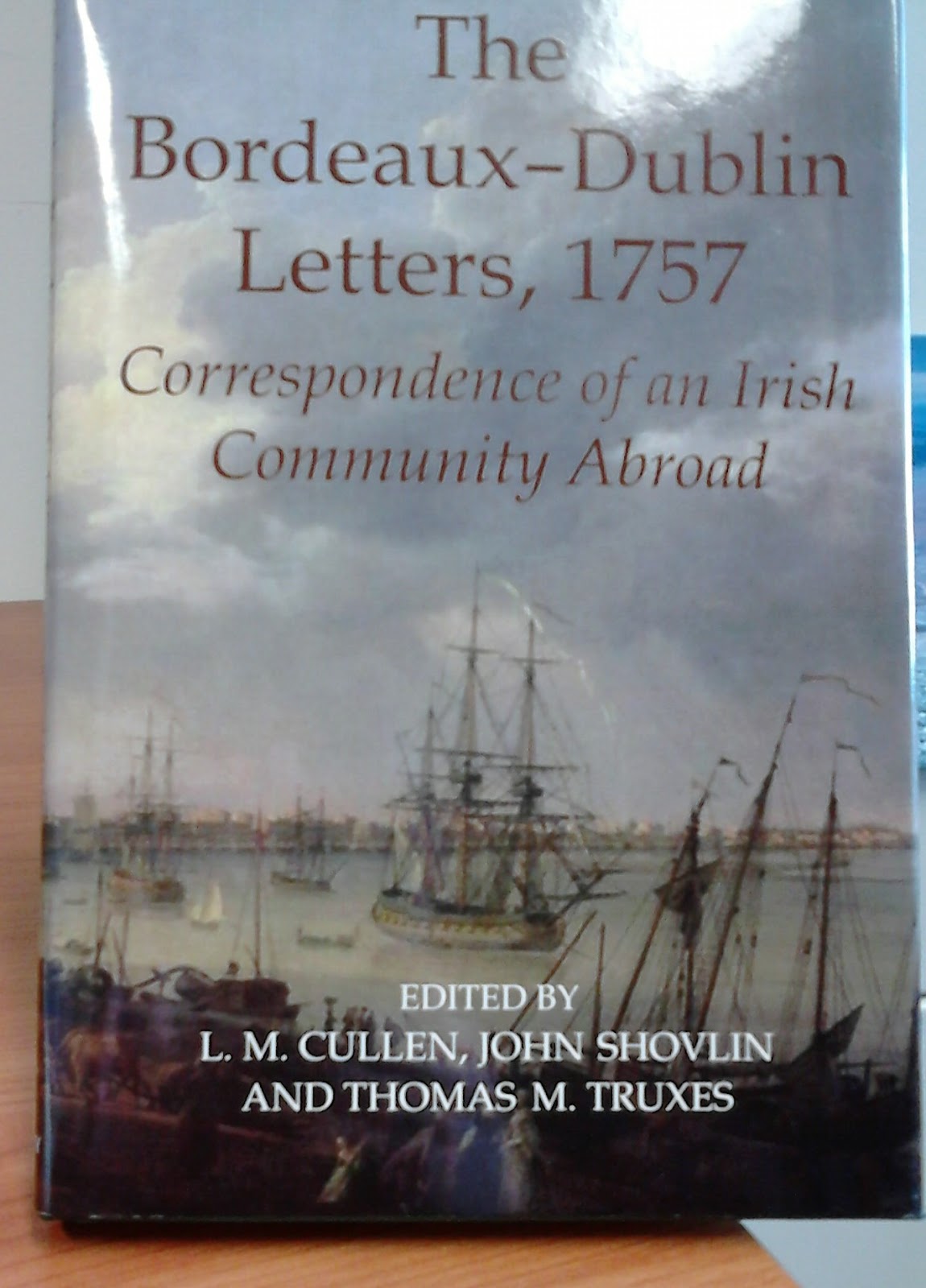
I recently reviewed the book, The Bordeaux-Dublin Letters, 1757: Correspondence of an Irish Community Abroad, for the journal Irish Studies Review. It has been published online and is available to read at: http://dx.doi.org/10.1080/09670882.2016.1147138

The book tells the fascinating story of a bundle of letters that were seized when a Dublin-registered ship was stopped by a British privateer in the Bay of Biscay in 1757. The letters and other related items formed part of a court case and were held in the British National Archives until they were rediscovered by accident by an American researcher in 2011.
Photograph of front cover of The Bordeaux-Dublin Letters, 1757.

It really was like finding a time capsule, a time capsule that transported the reader back 250 years witnessing how friendships, private relationships, as well as societies, operated. This was such an amazing find and reminds us of the fascinating discoveries still to be made in archives and libraries around the world.