Monday, 22 April 2019

Mary Swanzy 'Voyages' exhibition in Crawford Art Gallery - Cork, Ireland.

A new exhibition has recently opened in the Crawford Art Gallery in Cork, Ireland. It is entitled Voyages and showcases paintings by the Dublin-born artist, Mary Swanzy (1882-1978). It is truly amazing to see these works up close. The breath of artistic styles and techniques in her paintings is also something to behold.


'Cosmopolitan' and 'exotic' are just two of the words that come to mind when I think of Mary Swanzy. She was educated in Dublin and went to finishing school in France. She also went to a day school in Germany. Her artistic training took place in Dublin and Paris and she spent time in Yugoslavia and Czechoslovakia and captured local scenes on canvas. In the early 1920's, she traveled to Honolulu and Samoa, where she painted arrestingly vivid and vibrant outdoor scenes that must have seems like another planet to her painting admirers in Ireland.

Another word that comes to mind in relation to Swanzy is 'avant-garde'. In this exhibition, we can see the vast progress she made during her career, when she was painting in different styles from cubism and futurism to surrealism. If you look below, you can see some of the different styles and judge for yourself. Oh and a word of advice - Go and see this exhibition! It runs until 3 June 2019. More information here.

'Market Scene', 1920-21 (oil on canvas).

'Untitled: Window with Airplanes', 1940s (oil on canvas).

'Allegory', c.1945-49 (oil on canvas).

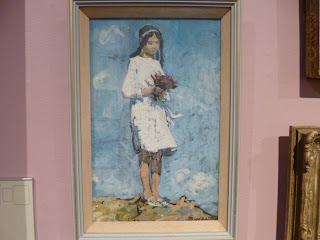
'Girl on a hill', 1913-15 (oil on board).

'Fieldworkers', 1914 (oil on board).

'Tulips', c. 1918 (oil on canvas).

'Honolulu Garden', 1923 (oil on canvas).

Sunday, 14 April 2019

Call for Papers - 'The Press and Divided Societies', Belfast Nov. 2019.


The Call for Papers for the 2019 Newspaper and Periodical History Forum of Ireland (NPHFI) conference has just been released. This year's conference theme is 'The Press and Divided Societies'.

It will take place in the Institute of Irish Studies, Queen's University, Belfast on Friday 8 and Saturday 9 November 2019.

Send your abstracts to the NPHFI Secretary, Ray Burke, at nphficonference@gmail.com by 7 June 2019.

Call for Papers, 2019 NPHFI Conference.

Tuesday, 9 April 2019

An Irishman's Diary on Jan Łukasiewicz, Polish professor of logic

Jan Łukasiewicz came to Ireland in March 1946 at the invitation of the then Taoiseach, Eamon de Valera. Łukasiewicz was a talented mathematician and philosopher who, like so many of his compatriots, had experienced great hardship during the Second World War.

I have just written an Irishman's Diary in the Irish Times newspaper about his life in Poland and his time in Ireland. Read it here.

Colour photograph of Jan Łukasiewicz. Image source.

Łukasiewicz was the man who introduced mathematical logic into Poland. For more information on Łukasiewicz and the impact he had on his field, I recommend that you read the entry on him in the Stanford Encyclopedia of Philosophy. It retraces his life in Poland and shows the part he played in the areas of logic, philosophy and mathematics. Read it here.

Plaque outside home where Łukasiewicz lived on Fitzwilliam Square in Dublin, Ireland.
Headstone in Mount Jerome Cemetery, Dublin, Ireland. Thanks Brian.

Wednesday, 27 March 2019

Martyn Turner cartoon exhibition in University College Cork, Ireland.


'The Times We Live In: Martyn Turner's Satire'

I was delighted to see this exhibition of cartoons by Martyn Turner in University College Cork (UCC) recently. The exhibition was previously on display in the Epic Emigration Museum in Dublin. It shows drafts of cartoons by Turner, whose work has appeared in the Irish Times newspaper for the last 45 years.

You can get so much into a cartoon and say things more concisely than you ever could in an article. The real beauty of political (or editorial cartoons as they are sometimes called), is that you are not as restricted as you might be when using text to get your message across to your audience. 'You can draw implicitly what you cannot say explicitly', as someone once said.

Seeing these drafts is great because you can see where he made changes as the work progressed. You can see things rubbed out and redrawn or names or words changed. Below are some of Turner's cartoons that were on display in UCC. I have selected a small number of them, but as you can see, he covers a wide range of subjects from the environment and housing to politics, international relations and everything in between.


When thinking of contemporary political cartoonists, I like the work of Patrick Chappatte, whose cartoons appear in a number of magazines and newspapers including, Der Spiegel and Le Temps. Below is one of Chappatte's award-winning cartoons from the New York Times.
Cartoon by Patrick Chappatte. Source: New York Times.

I also like the French review Revue XXI, which is like a newspaper, except instead of giving you the news and telling you stories with text and images, it uses cartoons. Cartoonists present us with stories from around the world.

Reveu XXI is reminiscent of grand reportage articles that appeared and still appear in French newspapers, where a grand reporter journalist will travel to a country where a news story is developing and send back a colourful article full of the flavour and taste of what they find on the street.

In any one edition of the review, you could find wildly different styles of cartoon and stories from all over the planet. It's well worth checking it out, if you haven't already.
Image from a story in Revue XXI by Jeff Pourquié. Source: Revue XXI.

Monday, 18 March 2019

'Writing the Troubles' Blog - my post.

Photograph taken from the 'Writing the Troubles' blog.

The Northern Ireland 'Troubles' (1968-1998) claimed over 3,500 lives and left many more maimed or scarred for life. It grabbed headlines in Britain, Ireland and around the world because of the shear scale of the killings, bombings and attacks and the length of the conflict.

I have just written a blog post on the Writing the Troubles blog about foreign reporting of the Troubles. Read it here.

Monday, 11 March 2019

An Irishman's Diary on the Léon XIII

In October 1907, the village of Quilty in Co. Clare, Ireland was the scene of a dramatic maritime rescue. The three-masted Nantes registered ship, Léon XIII, was bringing grain from Portland, Oregon to Limerick, when tragedy struck. A violet storm caused the ship's rudder to break, for the ship to be blown off course and to run aground and breakup.

The twenty-two French crew on board were rescued by a combination of a British Navy ship and currachs. Local fishermen from Quilty braved the elements and rowed their open currachs into the storm to rescue the sailors who had taken refuge in the rigging of the ship. I have just written an Irishman's Diary in the Irish Times newspaper about the rescue and the story of the Léon XIII. Read it here.

The legacy of the rescue and the Léon XIII is visible in Quilty to this day. See below photographs of items on display in the local church Stella Maris (Star of the Sea), which was built with money raised after the rescue.
Lifebuoy from Léon XIII.
Bell from Léon XIII

In 2011, 100 years after the church was completed, 17 new stained glass windows were installed. Below, you can see some of the new windows, which tell the story of the rescue of the sailors of the Léon XIII by the local fishermen.


Tuesday, 12 February 2019

The Irish Revolution - TV show

'The Irish Revolution' has just been broadcast on Ireland's state broadcaster, RTE. This three part tv series is based on the award-winning book, The Atlas of the Irish Revolution, which was published by Cork University Press.
Cover of the Atlas of the Irish Revolution from Cork University Press.

As a contributor to the Atlas, I was invited to attend a reception and a preview screening of programme no 2 in the Cork Opera House. I was very impressed by the programme, which was really put together well.

It presents all the facts about this turbulent time in Irish and world history and it does so with insights from some of the best-informed historians of today with archival footage and stunning photography of the Irish landscape. Check it out for yourself on the RTE Player.

The view I had during the preview screening in Cork Opera House.