Wednesday, 25 September 2019

Newspaper history conference - Belfast, Nov. 2019

The 2019 Newspaper and Periodical History Forum of Ireland (NPHFI) conference will take place in the Institute of Irish Studies in Queen's University, Belfast on Friday 8th and Friday 9th November 2019.

Speakers from universities in Ireland, UK, USA, India and Turkey will address the theme of 'The Press and Divided Societies'. The keynote address will be given by Andy Pollak, who has worked as a journalist, editor and writer.

Draft 2019 Conference poster.

Tuesday, 17 September 2019

The Tartan Pimpernel - An Irishman's Diary on Rev. Donald Caskie

Rev. Dr Donald Caskie helped to save the lives of over 2,000 Allied servicemen in France during the Second World War. I have just written an Irishman's Diary in today's Irish Times newspaper about him. Read it here.

Donald Caskie (1902-1983). Image source

Caskie was appointed as Minister in the Scots Kirk in Paris in the mid-1930s. He left the city when it was occupied by the Nazis in June 1940. He moved to Marseille and became part of an underground escape route that was organised by British intelligence.

They helped to hide stranded Allied servicemen and women and arrange their escape from France (usually over the Pyrenees to neutral Spain). He wrote about his wartime experiences in the book, The Tartan Pimpernel, which was published in 1957. It is a truly remarkable story of courage.

Friday, 30 August 2019

'The voice of Erin' - an Irishman's Diary on tenor William Dunlea

William Dunlea (1911-1998) was known as 'The voice of Erin'. The tenor was born in the suburb of Blackpool in Cork, Ireland, but was know for his singing all over the world, particularly in England and America where he lived and worked for a number of years.

I have just written an Irishman's Diary in the Irish Times newspaper about him. Read it here.

William Dunlea (1911-1998). Image source.

In the 1940s and 1950s, Dunlea sang on the radio in Ireland (Radio Eireann). He also sang on radio in England (BBC) and America, where he lived for a number of years. He performed in venues all over England and the United States including the Royal Albert Hall in London and in Carnegie Hall in New York.

A plaque in Blackpool, Cork, Ireland dedicated to their famous son, William Dunlea.

In 2008/09, Cork City Library held an exhibition on Dunlea. A book was also written by local historian, Jim McKeon and it details Dunlea's life story. You can download a PDF version of the book here from the Library website.

Tuesday, 20 August 2019

Howth lighthouse - entry on Gallica (French National Library)

You never know what little historical gems you will find online! That's what I thought when I came across a brief reference to Howth lighthouse when searching recently on Gallica, the digital library of the French National Library.

I was surprised to find an entry in the Journal de Paris, Bulletin de Commerce from 2 July 1818 which spoke about a new lighthouse in Howth that will be lit up for the first time. Howth is a fishing village in north County Dublin, about 16 km from Dublin city in Ireland.


Entry in Journal de Paris, Bulletin de Commerce, 2 July 1818. Source


My English translation of the entry.

As you can see from the photograph below, the lighthouse is a very impressive looking solid granite building. It was built in 1817. You can read a small bit about its history here on the Archiseek webiste. It sits at the end of the pier and is still in use today. However, in recent years, another lighthouse was built on an extension to the harbour wall and sadly, I think that it has taken precedence over the older lighthouse for navigation purposes. 

Howth harbour lighthouse.

Tuesday, 6 August 2019

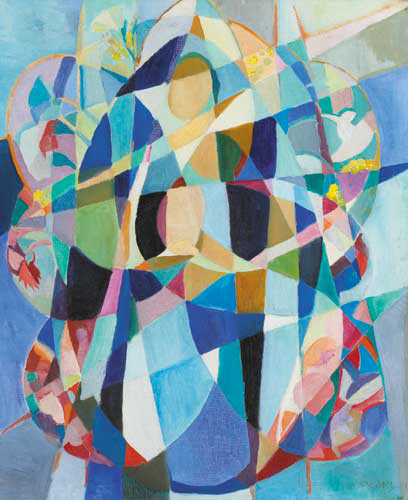
Fr Jack Hanlon, Painter priest - an Irishman's Diary

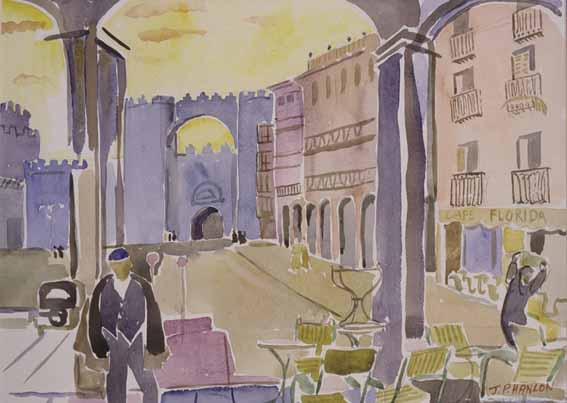
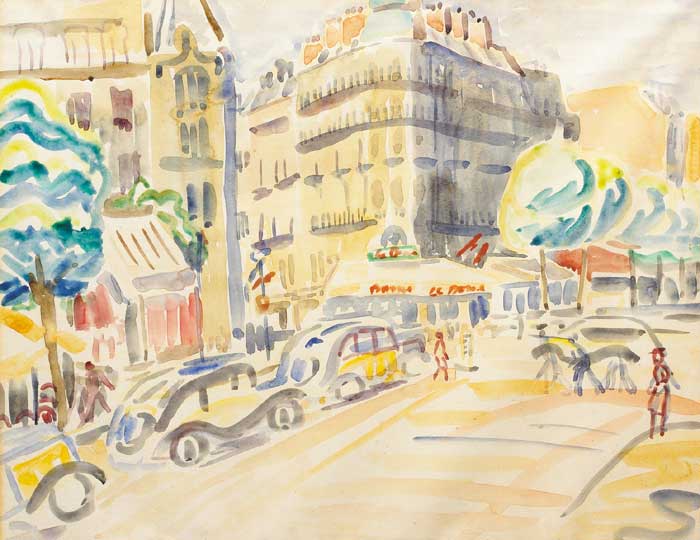
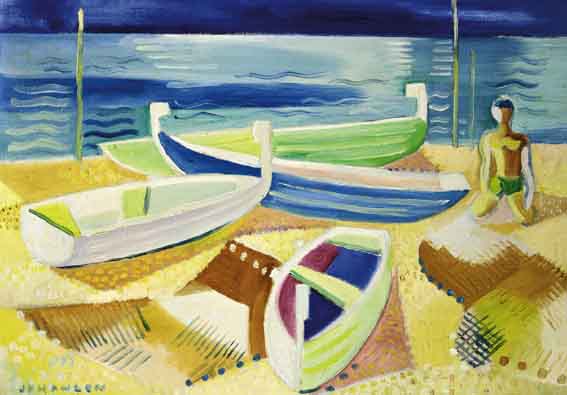
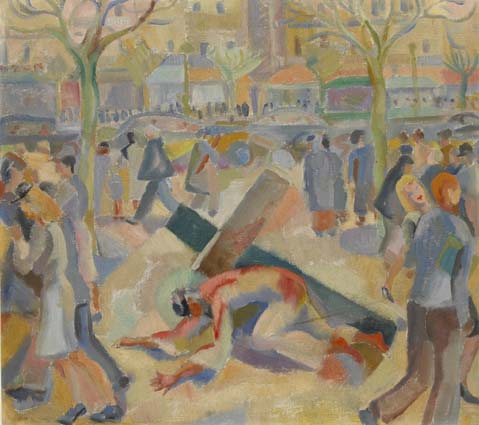
I have just written an Irishman's Diary in the Irish Times newspaper about the talented Irish artist, Fr Jack Hanlon (1913-1968). Read it here.

Fr Hanlon was an Irish Roman Catholic priest who also found time to be a modernist painter. He was friendly with other successful artists such of the time, such as Mainie Jellett, and was one of the founders of the Irish Exhibition of Living Art, which provided up and coming artists with a venue to exhibit their work.

His paintings are so full of light and colour. Below are some examples of his artwork in a range of artistic styles from French modernism to Cubism. They are taken from this page on the Whyte's auctioneers website dedicated to his art.

Jack Hanlon (1913-1968)

'Cafe Florida, France'. Image source

'The Dome, Paris'. Image source

'Boats On The Côte d'Azur'. Image source

'Christ Falls For The First Time'. Image source

'Madonna'. Image source

Tuesday, 23 July 2019

Joseph Kessel - died 40 years ago today (23 July 1979)

Joseph Kessel (1898-1979) lived a very full live. You could even say that he lived several lives, because of the amount that he fitted in during his lifetime. He was born in Villa Clara, Argentina to Jewish parents who had made their way to South America from the Russian Empire (what is today Lithuania). He started off in journalism and later wrote many bestselling books of fiction and books based on his travels to exotic places around the world.

IRELAND

One of his earliest foreign journalistic missions was to Ireland. He arrived in Dublin in September 1920 and wrote a series of special articles for the Paris evening newspaper, La Liberté. The Irish War of Independence was a dangerous time, but Kessel managed to speak to many of the main protagonists and write a series of articles on what he witnessed on the ground. It was a very important training exercise for the young journalist and he would later describe his time in Ireland as "mon premier grand reportage".

Photograph of Joseph Kessel in 1927. Image source

BELLE DE JOUR

Kessel spent the next few years writing novels, but still kept up writing newspaper articles for a variety of newspapers. One of his early novels, Belle de jour (1928), was adapted for the cinema by Luis Buñuel in 1967. The film stared Catherine Deneuve and took several awards at the Venice Film Festival that year. The film also introduced Kessel to a wider audience both at home and internationally.

CHANT DES PARTISANS

Kessel had been an aviator in the First World War and during the Second World War, he volunteered to fight for De Gaulle's Free French Air Forces in London. However, his biggest contribution to the war effort was a song that he wrote with his nephew, Maurice Druon. Kessel and Druon wrote the lyrics for Le Chant des Partisans in 1943. It soon after became the hymn of the Resistants and is still revered in France to this day for the way it galvanised the Resistants' resolve to win the war. You can listen to an extract of the song here.

There is much more that could be written in this blog post about Kessel's achievements, but I wanted to keep it brief to hold your attention. You can read a short obituary that appeared in the New York Times two days after his death on 23 July 1979.

Perhaps the best advice I can give you is to read one of his books. You will either find them in your local library, or many of his books are still in print today. If you do not understand French, they have been translated into many other languages. 

Wednesday, 12 June 2019

Éric Tabarly, Legendary French sailor - An Irishman's Diary

The name Éric Tabarly might not mean much to some people, but if you like boats and sailing, it is key. Tabarly (1931-1998) popularised the sport of sailing in his native France by winning a series of solo and group sailing titles, including the trans-Atlantic, trans-Pacific, Fastnet Race and the Channel Race. I have just written an Irishman's Diary in the Irish Times newspaper about Tabarly and his famous boat, Pen Duick. Read it here.

Photograph of Éric Tabarly. Image source.

The name Pen Duick (meaning 'coal tit' in Breton) is synonymous with Tabarly. The original Pen Duick boat was built in Cork, Ireland in 1898 for a member of the Royal Cork Yacht Club (RCYC). It was designed by the Scottish yacht designer, William Fife III. The Tabarly family bought the boat in 1938. 

Over the years, Tabarly had other Pen Duicks built to compete in various races. He added his own suggestions to the new designs. There were six built altogether, but the Pen Duick IV (renamed Manureva in 1973) was lost during the 'Route du Rhum' race in 1978. The original Pen Ducik has been restored several times, most recently this year. Find out more about the boats on the Association Éric Tabarly website.

Photograph of Pen Duick. Image source.