Showing posts with label Journalism. Show all posts

Wednesday, 9 September 2026

Book Launch - Dublin 6 October 2026


Please join us to launch Freedom of Speech in the Press in Times of Conflict: Historical Perspectives from Ireland and Europe 
in the Museum of Literature Ireland (MoLI), 86 St. Stephen's Green, Dublin 2 at 6pm on Tuesday 6 October 2026.

Edited by Prof Richard C. Allen, Felix M. Larkin, Dr Oliver O'Hanlon and Prof Aoife Whelan, the book will be launched by the historian and broadcaster Dr David McCullagh.

The book came about following a conference organised by the Newspaper and Periodical History Forum of Ireland (NPHFI). The book's table of contents is reproduced below and you can order a copy of the book on the publisher's (Peter Lang) website. It is the latest in Peter Lang's series on Studies in Franco-Irish Relations. Thanks to Eamon Maher (Series Editor) and Anthony Mason (Peter Lang) for their assistance during the publishing process.

Register here to attend the book launch on Tuesday 6 October at 6pm.


Friday, 5 June 2026

Book chapter published - Freedom of Speech in the Press in Times of Conflict

Delighted to say that I received a copy of the book Freedom of Speech in the Press in Times of Conflict: Historical Perspectives from Ireland and Europe (Oxford: Peter Lang, 2026), ed. by Richard C. Allen, Felix M. Larkin, Oliver O'Hanlon and Aoife Whelan. Details of this book are available on the publisher's website here.

 
Front cover of Freedom of Speech in the Press in Times of Conflict

My chapter (pp. 55-77) examines the work of Art O'Brien, who was the first Dáil's publicity man in London during the Irish War of Independence. He was responsible for disseminating the message of the 1st Dáil (whose term ran from January 1919 to August 1921) to the foreign press corps based in London and the outside world. He was in constant contact with the Dáil's Publicity Department in Dublin and the various heads of that Department.

The 1st Dáil met for the first time in Dublin's Mansion House before it was outlawed in September 1919. It had to meet in secret thereafter. As such, O'Brien had to be extremely careful when carrying out his mission. You can read more about O'Brien in his entry in the Dictionary of Irish Biography or if you want to go further, I would recommend the biography by Mary MacDiarmada Art O'Brien and Irish Nationalism in London, 1900-25.  


Table of contents.

As you can see from the table of contents reproduced above, the book covers a range of subjects in Ireland, France, Spain and Germany at different times of conflict. I am grateful to my fellow editors, Richard Allen, Felix Larkin and Aoife Whelan, and to the other contributors for all their hard work in bringing this volume to fruition

Andreas Strobl

Michael Foley

Claire Dubois

Claire Guerin

Alan McCarthy +

William Burton

Conor Campbell

Karine Deslandes 

+ Dr Alan McCarthy - sadly Alan did not live to see this volume in print. There is a tribute to Alan on the UCC School of History website, you can read it here. He was a great scholar and a really nice human being. He will be missed.
 

Saturday, 28 February 2026

More Irish-themed covers of Le Petit Journal - Abbey Theatre Riot Feb 1926

I have previously written here about Irish-themed covers of the French illustrated periodical Le Petit Journal illustré. Another one to add to the list was published on this day (28 February) in 1926. It concerns the Abbey Theatre riot that took place in the Abbey Theatre in Dublin on 11 February 1926 when some audience members reacted angrily to a staging of Seán O'Casey's play The Plough and the Stars. You can find out more about the incident here.

 
Back cover of Le Petit Journal 28 February 1926. Image source
 
Page 2, Le Petit Journal 28 February 1926. Image source.  

The illustration of the riot was accompanied by a short description of what happened on the night. It was, according to the newspaper, 'something that could only take place in Ireland'. 'Things came to blows and the women grabbed each other's hair', it went on. 

W.B. Yeats tried in vain to separate the fighters and address the crowd but his efforts failed. The theatre was eventually cleared and closed. According to the newspaper, 'with the tenacity that marks the Celtic race, the directors of the Abbey and their actors claim that they will go on staging the play as they had planned'. 

Friday, 19 July 2024

Talk in Glasnevin Cemetry on William Lombard Murphy - 14 July 2024

Every year the French embassy in Ireland holds a ceremony at Glasnevin Cemetery in Dublin to honour those Irishmen who fought for France. This includes those who fought during the Franco-Prussian War (1870-1871), the First World War (1914-1918) and the Second World War (1939-1945). It usually takes place on France's national holiday - 14 July.


Photograph of me speaking at the ceremony in Glasnevin Cemetery 14 July 2024.

Every year for the last number of years, an Irish recipient of the French Légion d'honneur is commemorated after the ceremony. This year it was William Lombard Murphy (1876-1943) who was remembered at the graveyard. I was asked by the embassy to speak about Dr Murphy's life and times. I was pleased to do so and was delighted to meet members of his extended family who were present at the ceremony. I am writing a newspaper article based on my speech and will share more details as soon as it is published.

Monday, 30 October 2023

Irish themed covers of Le Petit Journal illustré

Every Monday morning for the last number of years, I have been tweeting (posting) the front page of the weekly French illustrated periodical Le Petit Journal illustré from 100 years ago. Occasionally, events in Ireland made the front page or the back page (they both contained a drawn image of whatever was making the news in France or around the world that week). 

I have listed below some of the covers relating to an Irish story. The first is from September 1920 and deals with the death of the Lord Mayor of Cork, Terence MacSwiney, in October 1920 after 74 days on hunger strike in Brixton prison. 

The last cover also refers to MacSwiney, in a way, as it shows prisoners in Mountjoy prison in Dublin on hunger strike in the aftermath of the Irish Civil War. The caption reads A l'exemple du Maire de Cork [following the Mayor of Cork's example]. It says that 424 prisoners have been on hunger strike since 14 October 1923. The images come from Gallica - the digital library of the Bibliothèque nationale de France.

 
Le Martyr Irlandais - Death of Terence MacSwiney. 19 September 1920. Source

Les Évéments d'Irlande - Irish War of Independence. 5 December 1920. Source

 
Le Sous-Marin Fantôme - Irish War of Independence. 3 July 1921. Source
 
Un assassinat politique - Assassination of Henry Wilson. 2 July 1922. Source
 
Les convulsions sanglantes de l'Irlande - Assassination of Michael Collins. 3 September 1922. Source

A l'exemple du Maire de Cork - Hunger strike in Mountjoy prison. 28 October 1923. Source

Monday, 28 November 2022

Andrée Viollis - An Irishman's Diary

Andrée Viollis (1870-1950) was a French journalist who worked as a grand reporter - a curious combination of war correspondent and special correspondent. Her career in journalism began around the time of the Dreyfus Affair (1894) and lasted for much of the first half of the 20th century. 

I have just written a short article about her and her reporting from Ireland in the 1920s, in the Irish Times newspaper. Read it here.

Andrée Viollis (1870-1950). Image source.

Viollis traveled to Ireland during the Civil War, which lasted from June 1922 to May 1923. She did not seem to fear visiting a country that was experiencing such turmoil. During the First World War, she spent two years as a volunteer nurse at the front and saw her fair share of death and injury. Later, she worked as a journalist during the War. 

She was the only female correspondent to witness and write about the Paris Peace Conference (1919) and one of the few female foreign correspondents that came to Ireland at that time to write about what was happening. 

After Ireland, she made her name through her journalism and books (based on her newspaper articles) about travel to countries including Afghanistan, Armenia, Turkey, China and Japan. During the Second World War, she helped the Resistance in France by writing pamphlets and she transported them concealed in bags of wheat or nuts. 
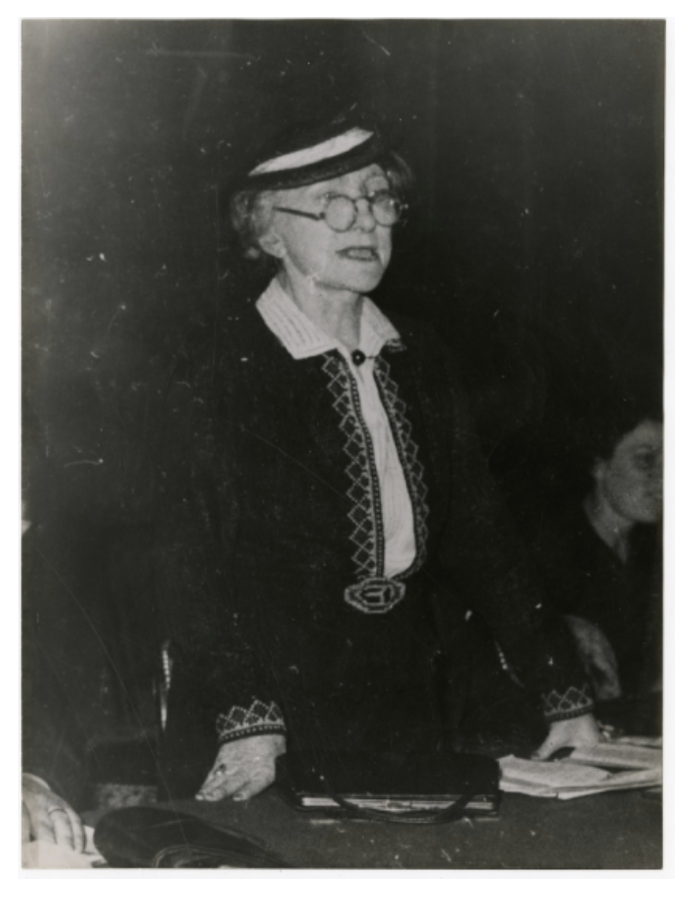
Andrée Viollis - Si/si, les femmes existent 

Photograph of Andrée Viollis (1938). Image source.

A committed member of the French Communist party, Viollis was always on the side of the worker. In 1926, she paid a visit to a Welsh coalmine and wrote about the hard working conditions that the miners had to endure. While some miners could sit up in the mine to extract the coal, others had to spend hours on their backs in mud in a coal seam just 32 inches high. 

Viollis' daughter, Simone Téry (1897-1967), was also a well-known journalist and Téry also traveled to Ireland in the 1920s. Téry arrived just after the Truce in the War of Independence and wrote for the left-leaning newspaper L'Oeuvre. Téry produced two books about Ireland, one on the political scene (based on her newspaper articles) and one about the cultural life of the country. It is easy to see where Téry's writing talent came from.