Friday, 24 July 2026
Ireland and the Tour de France piece on RTÉ Brainstorm
Wednesday, 15 July 2026
Irish in France in WW2 - RTÉ Brainstorm article
For Bastille Day this year, I thought I'd write something about the Irish who gave assistance to France during the Second World War. Some of those who risked their lives as volunteers in the Resistance are well known (like Samuel Beckett) or those who helped out through humanitarian initiatives (like Mary Elmes), but others will not be that familiar to you. Read it here on the RTÉ Brainstorm website.
The French Resistance carried out a range of activities including non-violent civil defiance and organised guerilla warfare. They ran underground newspapers and gathered intelligence. It is estimated that between 1 and 3% of the French people took part in the Resistance. Find out more about it here and here.
Many of the Irish who took part in Resistance activity in France did so as members of the British Special Operations Executive (SOE). This was an organisation set up in July 1940 at the instruction of Winston Churchill to help local resistance movements and carry out espionage and sabotage in enemy held territories. You can find out more about the SOE here. According to this article, only 39 women were selected to be part of the SOE Section F or French section. This article by David Murphy contains a good precis of the Irish were part of Section F.
One of those who helped by giving assistance and giving hope was Cork-born Mary Elmes (1908-2002), who carried out essential humanitarian work in France during the War. She helped set up and run refugee camps for people fleeing Franco's nationalist forces in Spain. She provided education for the children in the camps and helped hundreds of Jewish children avoid certain death at Auschwitz concentration camp. She is remembered in her native city with a new pedestrian bridge bearing her name.
Saturday, 28 February 2026
More Irish-themed covers of Le Petit Journal - Abbey Theatre Riot Feb 1926
I have previously written here about Irish-themed covers of the French illustrated periodical Le Petit Journal illustré. Another one to add to the list was published on this day (28 February) in 1926. It concerns the Abbey Theatre riot that took place in the Abbey Theatre in Dublin on 11 February 1926 when some audience members reacted angrily to a staging of Seán O'Casey's play The Plough and the Stars. You can find out more about the incident here.
The illustration of the riot was accompanied by a short description of what happened on the night. It was, according to the newspaper, 'something that could only take place in Ireland'. 'Things came to blows and the women grabbed each other's hair', it went on.
W.B. Yeats tried in vain to separate the fighters and address the crowd but his efforts failed. The theatre was eventually cleared and closed. According to the newspaper, 'with the tenacity that marks the Celtic race, the directors of the Abbey and their actors claim that they will go on staging the play as they had planned'.
Friday, 19 September 2025
RTÉ Brainstorm piece on the Sacré-Coeur basilica in Paris
Many visitors to Paris will have seen the Sacré-Coeur Basilica on the butte of Montmartre. Some will have traveled there and walked up the steps to see the city stretch out below them. Some will even have entered the church but many do not know the history the building which has eared a place in almost every guidebook to Paris. I have just written a piece on the RTÉ Brainstorm website on the history of the basilica. Read it here.
As I mention in the article, controversy has surrounded the building from the beginning. For some it has come to be seen as a "key monument of modern French Catholicism" and for others, it is a symbol of the influence of the Catholic Church in state affairs.
According to Martin Evans and Emmanuel Godin, the "Sacré-Coeur served the symbolic purpose of asking for forgiveness for the sins of the atheist Commune. However, for Republicans it came to stand for the worst excesses of clerical domination". [France Since 1815, (London: Routledge, p. 65)].
On a recent visit to Paris, I was able to see the crypt, which is not normally open to all visitors. It was amazing to see the size of the crypt with its windows, high ceilings and many altars. Architecturally, the Sacré-Coeur is a stunning example of a craftsmanship. Engineering-wise, it is an example of what can be done in a challenging location. Below is a photograph of the crypt.
Have you ever visited the Sacré-Coeur basilica?
Wednesday, 23 July 2025
RTÉ Brainstorm piece on La Ferme Irlandaise Irish Restaurant in Paris
La Ferme Irlandaise was an Irish restaurant in the heart of Paris. It served Irish food and the staff who were there were Irish. I have just written a short article on RTÉ Brainstorm about the restaurant. Read it here.
The restaurant was the brainchild of Paddy O'Keeffe who was Chairman of investment cooperative Farmers' Business Developments (FBD) and editor of the Irish Farmers' Journal. Myrtle Allen of Ballymaloe Restaurant acted as an advisor for the restaurant. The classically-trained chef Peter Robinson ran the restaurant for the first couple of years from its opening in November 1979 until 1981.
It was then taken over by Myrtle Allen who sent staff from Ballymaloe to run the restaurant in Paris. She traveled over to the restaurant every few weeks to make sure that it was running smoothly. The decor and menu changed when she took over and it became even more 'Irish' than it had been.
The new menu included a full Irish breakfast of sausages, bacon and eggs, which was very popular with the customers. They also served dishes such as Shangarry beef and Guinness pie and Irish lamb with mint and butter sauce. The Allens ceased to be involved in La ferme irlandaise in 1985 and the restaurant closed in 1987. It remains one of the most novel and interesting showcases for Irish food and Irish cooking on the continent in recent times.
Thanks to Bryan Barry of FBD and John McCullen for providing information on the history of the restaurant.
Wednesday, 16 July 2025
Talk in Glasnevin Cemetery on Bastille Day about Liam Ó Briain
Every year on 14 July (Bastille Day), the French embassy in Ireland organises a wreath laying ceremony to remember the Irish who fought in France. It takes place at the dedicated France-Ireland Monument in Glasnevin Cemetery in Dublin.
After the ceremony, an Irish recipient of the French national order of merit, the Légion d'honneur, is remembered with a wreath laying ceremony at their graveside. This year, it was Liam Ó Briain (1888-1974) who was remembered and I was asked to say a few words about him.
I was pleased to be asked to speak and share the information that I had learned about him in my research. He was passionate about the Irish language and did his best to revive it, notably through founding Taibhdhearc na Gaillimhe, Ireland's national Irish language theatre. He was Professor of Romance Languages in what is now University of Galway for over 40 years and translated many works from French into Irish including plays by Henri Ghéon, Pierre Jalabert and Molière.
If you would like to find out more about him, a good place to start would be the Dictionary of Irish Biography and Ainm.ie.
Monday, 5 May 2025
An Irish Diary on Etiennette Beuque
Etiennette Beuque (d. 1949) was fascinated with Ireland. The French writer became interested in Ireland and Irish history around the time of the Easter Rising and the War of Independence. She ultimately became very attached to Eamon de Valera's republican politics and wanted her compatriots to share her knowledge of Ireland and Irish history. I have just written an Irish Diary in today's Irish Times newspaper about Beuque and her interest in Ireland. Read it here.
Pour L'Irlande by Etiennette Beuque from the Boole Library Special Collections.
As mentioned in my article, Beuque wrote several books in French about Ireland (including Pour L'Irlande above). Her non-fictions books focused on Irish history, particularly what happened to Ireland under British rule and also the independence movement. Her fiction novels used the Easter Rising as a focal point and they demonstrate her partiality for the republicans.
Beuque was an interesting writer. She was not a journalist or a professional writer but she managed to write a great deal about her favourite subject of Ireland. Historian Pierre Joannon called her 'a pro-Irish fanatic'. Beuque planned to write a book on Terence MacSwiney (1879-1920), the lord mayor of Cork who died in prison in England, but gave up on the idea after the Second World War. She said that she decided not to write it in recognition for the assistance that Britain gave to France during the war. If you have any information on Etiennette Beuque, please let me know.
Friday, 20 December 2024
Irish traditions around Christmas - post on RTÉ Brainstorm
Several traditions and customs in Ireland around Christmas time date back centuries. Some are still observed today even though Ireland and Irish society have changed over time.
One tradition that is still common in some parts of the country is the celebrations that take place on St. Stephen's Day or the Wren's Day as it is also known when people dress up and disguise themselves. In the past, they went from house to house asking for a donation to 'bury the wren'. Today, there is usually a charitable element to the enterprise where people dress as 'straw boys' as in the photograph from Carrigaline at the bottom of this post. I have just written a piece for RTÉ Brainstorm website about it. Read it here.
Marie-Louise Sjoestedt (1900-1940) wrote about her first-hand experience of having a group of 'wren boys' come into the house where she was staying in Kerry at Christmas 1929. It is interesting to read about her impression of the festive period and the good natured celebrations. I wrote another Brainstorm piece on Sjoestedt and her connection to Ireland a little while ago. Read it here.
Monday, 27 May 2024
An Irish Diary on L'Opéra d'Aran by Gilbert Bécaud
The Aran islands that lie off Ireland's west coast are a special place. This is due to their physical landscape of stone walls and karst limestone and the importance of the Irish language to daily life on the islands.
Down through the centuries, they have inspired artists, writers and poets and have attracted international attention. I have just written am Irish Diary in the Irish Times newspaper about an opera set on the Aran islands that was written by a Frenchman. Read it here.
Gilbert Bécaud (1927-2001) was a popular singer and composer who was known as 'Monsieur 100,000 volts' and 'Monsieur Dynamite' on account of his engaging and electrifying stage performance. If you would like to find out more about him, have a look at the conference paper that Axel Klein gave at the Association of Franco-Irish Studies (AFIS) conference in Dublin in 2014. Read it here.
If you would like to hear Bécaud speak or listen to some of his music, there are a number of programmes on the Radio France website about him and his music. Just enter his name into the website's search bar like this and see what you can find.
Monday, 30 October 2023
Irish themed covers of Le Petit Journal illustré
Every Monday morning for the last number of years, I have been tweeting (posting) the front page of the weekly French illustrated periodical Le Petit Journal illustré from 100 years ago. Occasionally, events in Ireland made the front page or the back page (they both contained a drawn image of whatever was making the news in France or around the world that week).
I have listed below some of the covers relating to an Irish story. The first is from September 1920 and deals with the death of the Lord Mayor of Cork, Terence MacSwiney, in October 1920 after 74 days on hunger strike in Brixton prison.
The last cover also refers to MacSwiney, in a way, as it shows prisoners in Mountjoy prison in Dublin on hunger strike in the aftermath of the Irish Civil War. The caption reads A l'exemple du Maire de Cork [following the Mayor of Cork's example]. It says that 424 prisoners have been on hunger strike since 14 October 1923. The images come from Gallica - the digital library of the Bibliothèque nationale de France.
A l'exemple du Maire de Cork - Hunger strike in Mountjoy prison. 28 October 1923. Source
Monday, 19 June 2023
The French Festival, Dublin 1962 - An Irishman's Diary
The French Festival took place in Dublin from 26 April to 8 May 1962. It was a cultural and industrial showcase put on by the French authorities to win hearts and minds (and perhaps wallets as well) in Ireland. I have just written an Irishman's Diary about it in the Irish Times newspaper. Read it here.
The Festival was opened by Seán Lemass and he said that he hoped that it would renew the old ties that existed between the two countries. It took place in an Ireland very different from today's Ireland. The Festival was covered extensively in the Irish press as if it was something of immense importance. France was portrayed as an exotic land full of haute couture and fine dining (common stereotypes at the time I suppose, although they still be valid to this day, depending on who you ask). As mentioned in my article, the one dissenting voice was in the Cork Examiner. On the same day that the 'Dublin Letter' appeared saying that the French had come to Dublin in search of "more business", the editorial discussed the state of French politics in light of the Algerian War, which came to an end in March 1962.
The writer of the Irishman's Diary at the time, Quidnunc, labelled it a "whirlimagig" - probably due to the amount of events and variety of events that took place during the fortnight. As well as the formal events in the Mansion House and the Building Center on Lower Baggot Street, the French film Archimède, le clochard [The Tramp], starring Jean Gabin (1904-1976), was shown in the Ambassador Cinema at the top of O'Connell Street.
A French frigate, Commandant Rivière, spent a week at the quayside in Dublin. Its crew entertained on board and were brought on a tour of the Guinness brewery. They also played a football match with Irish soldiers and there was a dinner arranged for them at MacKee barracks, which was attended by the Chief of Staff of the Irish Defense Forces.
A French policeman directing traffic on Baggot Street with a Garda during the French Fesitval.
Over forty cases of cheese were flown in for the fortnight and they were sold in shops and restaurants around Dublin. A shop on Chatham Street, the Farm Produce Co., advertised that it was selling Brie and Camembert as well as the not so common varieties Saint-Paulin and La Grappe.
Monday, 28 November 2022
Andrée Viollis - An Irishman's Diary
Andrée Viollis (1870-1950) was a French journalist who worked as a grand reporter - a curious combination of war correspondent and special correspondent. Her career in journalism began around the time of the Dreyfus Affair (1894) and lasted for much of the first half of the 20th century.
I have just written a short article about her and her reporting from Ireland in the 1920s, in the Irish Times newspaper. Read it here.
Andrée Viollis (1870-1950). Image source.
Viollis traveled to Ireland during the Civil War, which lasted from June 1922 to May 1923. She did not seem to fear visiting a country that was experiencing such turmoil. During the First World War, she spent two years as a volunteer nurse at the front and saw her fair share of death and injury. Later, she worked as a journalist during the War.
She was the only female correspondent to witness and write about the Paris Peace Conference (1919) and one of the few female foreign correspondents that came to Ireland at that time to write about what was happening.
After Ireland, she made her name through her journalism and books (based on her newspaper articles) about travel to countries including Afghanistan, Armenia, Turkey, China and Japan. During the Second World War, she helped the Resistance in France by writing pamphlets and she transported them concealed in bags of wheat or nuts.
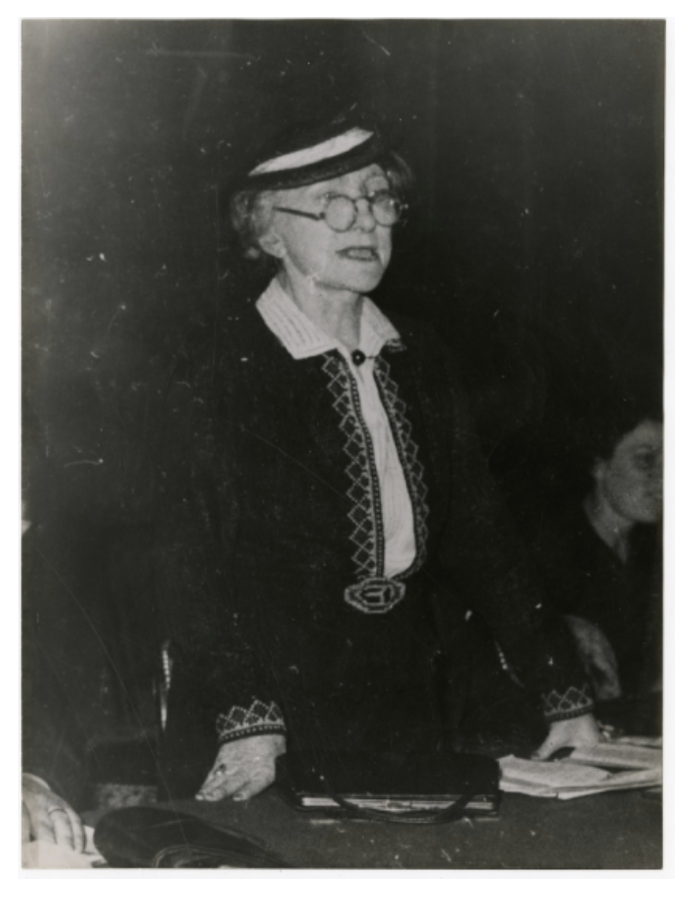
Photograph of Andrée Viollis (1938). Image source.
A committed member of the French Communist party, Viollis was always on the side of the worker. In 1926, she paid a visit to a Welsh coalmine and wrote about the hard working conditions that the miners had to endure. While some miners could sit up in the mine to extract the coal, others had to spend hours on their backs in mud in a coal seam just 32 inches high.
Viollis' daughter, Simone Téry (1897-1967), was also a well-known journalist and Téry also traveled to Ireland in the 1920s. Téry arrived just after the Truce in the War of Independence and wrote for the left-leaning newspaper L'Oeuvre. Téry produced two books about Ireland, one on the political scene (based on her newspaper articles) and one about the cultural life of the country. It is easy to see where Téry's writing talent came from.


