Showing posts with label editorial cartoons. Show all posts

Thursday, 17 March 2022

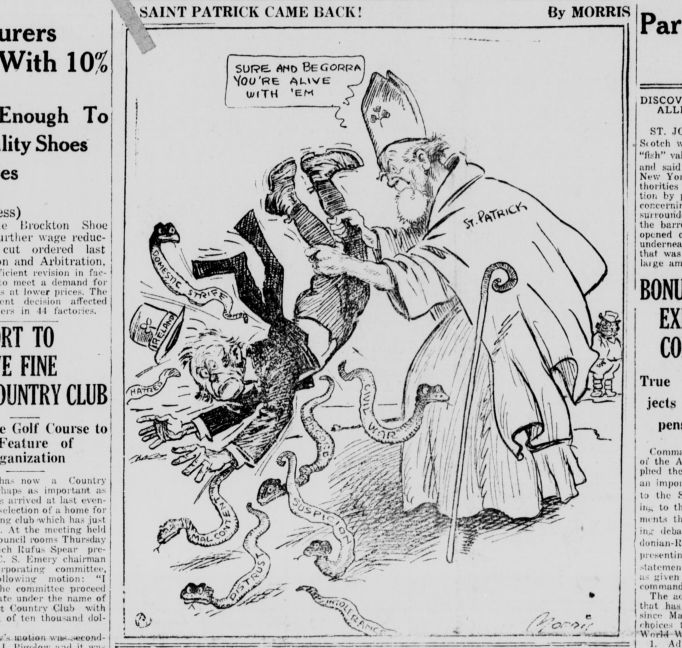
Saint Patrick's day themed newspapers cartoons in the American press 1922

I was a little surprised to find these Saint Patrick's Day themed newspaper cartoons in the American press on Saint Patrick's Day in 1922. I found them on the Chronicling America website which gives you access to digitised historic newspapers from all over the USA. On the homepage, there is a section labelled '100 years ago today' which links directly to editions from exactly 100 years ago.

These cartoons, published on 17 March 1922, deal with Ireland's present state now that the Irish Free State has just been established and is finding its feet. Some are calling on Saint Patrick (who is famously known for ridding Ireland of snakes!) to return to rid Ireland of more 'snakes'. The Irish Civil War would start some months later - on 28 June 1922.

https://pbs.twimg.com/media/FOFM14RXwAAs2Ad?format=png&name=900x900

The Albuquerque Evening Herald. Image source.

https://pbs.twimg.com/media/FOFOiDUX0AoHghq?format=png&name=900x900

The Caledonian Record. Image source.

https://chroniclingamerica.loc.gov/iiif/2/mnhi_nimrod_ver01%2Fdata%2Fsn86063381%2F00280767128%2F1922031701%2F0461.jp2/1849,893,2244,2138/681,648/0/default.jpg

The Bemidji Daily Pioneer. Image source.

https://chroniclingamerica.loc.gov/iiif/2/iune_issue_ver01%2Fdata%2Fsn92053241%2F00295873401%2F1922031701%2F0488.jp2/1235,1003,2498,2379/681,648/0/default.jpg

Free Trader Journal and Ottawa Fair Dealer. Image source.

https://chroniclingamerica.loc.gov/iiif/2/pst_icecream_ver01%2Fdata%2Fsn83045211%2F00237281664%2F1922031701%2F1107.jp2/2855,240,3004,2861/681,648/0/default.jpg

Evening Public Ledger. Image source.

https://chroniclingamerica.loc.gov/iiif/2/dlc_cylon_ver01%2Fdata%2Fsn83045462%2F00280657086%2F1922031701%2F0409.jp2/1934,662,2007,1912/681,648/0/default.jpg

Evening Star. Image source.

Friday, 1 January 2021

Happy New Year!

It's always interesting to look through the newspaper archives to see what was happening at different points in history. The 1st of January of any year always presents us with great editorial cartoons and 1921 was no exception. 

Cartoon from L'Humanité newspaper, 1 January 1921. Image source.

In this cartoon from the left-leaning newspaper, L'Humanité (the daily newspaper of the French Communist party), we can see 1920 being unceremoniously dumped in the bin. The title 'Dans la poubelle' translates as 'In the trash / rubbish bin' and the caption at the bottom reads: 'Je n'en ai pas trouvé aussi sale depuis l'Empire...', which would be 'I haven't had it this bad since the days of the Empire...'.

Happy New Year, hope it's a good one for you and yours!

Friday, 11 December 2020

Article on RTE's Brainstorm - Burning of Cork in the French press

The Irish War of Independence, which lasted from January 1919 to July 1921, consumed gallons of newspaper ink in newspapers all around the world. During that time, certain significant events caused the focus to be amplified. One of those events was the Burning of Cork, which happened on the night of 11 December 1920. I have just written a piece for the RTÉ Brainstorm website about French press coverage of the Burning of Cork. Read it here.

Front page of Le Matin, 15 December 1920. Source.

The newspaper that is mentioned in the article on Brainstorm is L'Œuvre. The paper ran from 1904 until 1944 and during those years the paper's ideology altered radically from being non-conformist in the early years, to being a radical republican and pacifist paper in the inter-war years, to ultimately adopting a collaborationist stance during the Second World War. It has been digitised by the French National Library (BnF) and you can search through the archives from 1915 to 1944 on their digital website, Gallica. See here for more. 

If you want to find out more about the Burning of Cork, there is a podcast available on the RTÉ 'Documentary on One' radio programme website. It was made in 1960 and includes interviews with people who witnessed the event that took place on 11 December 1920. It lasts for 29.40 mins and you can listen to it here. There is also a shorter RTÉ radio clip (4.26 mins) on the Burning of Cork available. It was made by Myles Dungan and you can listen to it here.

Sunday, 25 October 2020

La meurte del alcalde de Cork - Spanish language press reporting on Terence MacSwiney's hunger strike and death.

I have already written on this blog about how Terence MacSwiney's hunger strike and death were reported in the French press. See previous posts here and here.

'The Hero Mayor'. Headline from La Accion, 9 September 1920.

'The Mayor of Cork is dead'. Headling from La Voz, 25 Oct 1920.

Now, I will briefly look at the reaction in the Spanish speaking press. 

During the Irish War of Independence, the words 'Sinn Feiner' and 'Sinn Feinista' became a common sight in the foreign press as articles and photographs appeared with increased regularity following an IRA ambush on an RIC station or patrol or British army patrol, or after a reprisal by the Crown forces. 

The First Dáil was aware of the power of the press in swaying public opinion. For that reason, they formed a network of press agents in cities around the world. In Madrid, Máire O'Brien (1882-1958) was tasked with contacting the Spanish press and informing them about what was happening in Ireland. 

In her memos back to Dublin, O'Brien says that British propaganda was far superior in getting their message across to the Spanish press as they had a network of Consuls and more resources than O'Brien (who seems to have been working almost single-handedly). A very interesting individual, you can read memos sent by O'Brien to Dublin and vice versa on the Documents on Irish Foreign Policy website. You can also read about her on the Military Pensions blog and see her entry on the Dictionary of Irish Biography.

Some Spanish journalists traveled to Ireland during the War of Independence to witness what was happening for themselves. One such journalist was Ricardo Baeza (1890-1956), who wrote for the Madrid-based newspaper, El Sol. He spent time in Ireland in 1920 and 1921 and produced many sympathetic articles in favour of Irish independence. He later wrote a book about his time in the country.

Below are some of the articles telling Terence MacSwiney's story in the Spanish speaking press.


Neuvo Mundo, 17 September 1920.

Caras y Caretas, (Buenos Aires) 30 October 1920.

Mundo Grafico, 3 November 1920.

In relation to the general newspaper coverage in Spain, Dermot Keogh has said that "it was in the right wing separatist press of Catalonia and the Basque country, seeing in Ireland a mirror image of their own struggle for autonomy from Madrid, that Sinn Fein received most support". [1]

To understand the reaction in Spain, the following journal article might be of interest: 

Alvaro Jaspe, 'Armada? What Armada? Spanish reaction to the 1916 Easter Uprising and the path to Irish independence', International Journal of Iberian Studies, 15/2 (2002), pp. 72-83. 

The newspaper articles above seem to be largely informative and possibly supportive of MacSwiney, but the cartoons below are a little less so. 

EDITORIAL CARTOONS

MacSwiney's case was so familiar to newspaper readers in Spain that some newspapers even decided to include references to him in their editorial cartoons. 

El Imparcial, 26 September 1920.

In this cartoon, one child says - 

'Mi papá dice que voy a ser general' [My dad says that I'm going to be a general]. 

The response is - 

'Pues el mio lleva tres dias castigándome sin postre, y es porque quiere que sea alcalde de Cork' [Well, mine has been punished for three days without dessert, and it's because he wants to be Mayor of Cork].

La Voz, 4 October 1920.

With the title, 'Incrédulos' [incredulous, disbelieving, gobsmacked], this cartoon shows two men looking aghast at what they read in a newspaper. 

One man asked the other - 

'Pero usted cree que pueda ya existor el alcalde de Cork?' [do you think the Mayor of Cork exists?]

His friend replies - 

'Hombre, lo que yo creo es que no ha existido nunca' [Man, what I believe is that he never existed]. 


Caricature of MacSwiney, Neuvo Mundo, 17 September 1920.

All of the images shown above came from the Hemeroteca Digital (digital newspaper archive / library) of the Biblioteca Nacional de Espana. It is a fantastic free resource with 2,371 newspaper titles running to an amazing 67 million pages. 


[1] Dermot Keogh, 'The Irish Foreign Service in Europe', Etudes Irlandaises (7), 1982, p. 145-164 (p. 154). 

Wednesday, 25 September 2019

Newspaper history conference - Belfast, Nov. 2019

The 2019 Newspaper and Periodical History Forum of Ireland (NPHFI) conference will take place in the Institute of Irish Studies in Queen's University, Belfast on Friday 8th and Friday 9th November 2019.

Speakers from universities in Ireland, UK, USA, India and Turkey will address the theme of 'The Press and Divided Societies'. The keynote address will be given by Andy Pollak, who has worked as a journalist, editor and writer.

Draft 2019 Conference poster.

Wednesday, 27 March 2019

Martyn Turner cartoon exhibition in University College Cork, Ireland.


'The Times We Live In: Martyn Turner's Satire'

I was delighted to see this exhibition of cartoons by Martyn Turner in University College Cork (UCC) recently. The exhibition was previously on display in the Epic Emigration Museum in Dublin. It shows drafts of cartoons by Turner, whose work has appeared in the Irish Times newspaper for the last 45 years.

You can get so much into a cartoon and say things more concisely than you ever could in an article. The real beauty of political (or editorial cartoons as they are sometimes called), is that you are not as restricted as you might be when using text to get your message across to your audience. 'You can draw implicitly what you cannot say explicitly', as someone once said.

Seeing these drafts is great because you can see where he made changes as the work progressed. You can see things rubbed out and redrawn or names or words changed. Below are some of Turner's cartoons that were on display in UCC. I have selected a small number of them, but as you can see, he covers a wide range of subjects from the environment and housing to politics, international relations and everything in between.


When thinking of contemporary political cartoonists, I like the work of Patrick Chappatte, whose cartoons appear in a number of magazines and newspapers including, Der Spiegel and Le Temps. Below is one of Chappatte's award-winning cartoons from the New York Times.
Cartoon by Patrick Chappatte. Source: New York Times.

I also like the French review Revue XXI, which is like a newspaper, except instead of giving you the news and telling you stories with text and images, it uses cartoons. Cartoonists present us with stories from around the world.

Reveu XXI is reminiscent of grand reportage articles that appeared and still appear in French newspapers, where a grand reporter journalist will travel to a country where a news story is developing and send back a colourful article full of the flavour and taste of what they find on the street.

In any one edition of the review, you could find wildly different styles of cartoon and stories from all over the planet. It's well worth checking it out, if you haven't already.
Image from a story in Revue XXI by Jeff Pourquié. Source: Revue XXI.