Showing posts with label Research Trip. Show all posts

Sunday, 24 March 2024

Magazine article - In Flanders Fields Museum (Friends Magazine)

A magazine arrived in the post today. It came from Ieper in Belgium and was sent by the In Flanders Fields Museum. It's the magazine of the Friends of the In Flanders Fields Museum and contains articles about the work of the museum and the history of the First World War. 

One of the articles was written by me! After completing a three week research visit to the museum in September 2023, I was asked to write about the research I carried out with another student from Ireland. The visit was organised in conjunction with the Irish embassy in Brussels and involved researching information on Irish men who fought in the First World War.

Magazine of the Friends of the In Flanders Fields museum.

 
Article in the Friends magazine.

My article (originally written in English) was translated into Dutch and published with photographs taken during our research visit to the museum, Commonwealth War Graves Commission graveyards and the Irish embassy in Brussels. I have such good memories from the visit to Ieper. Thanks again to Annick Vandenbilcke and all the team in the museum for all they did during the visit.

Sunday, 15 October 2023

Flanders Fields Bursary Scheme 2023

This is a short description of the time I spent in Belgium in September 2023 on the Flanders Fields Bursary Scheme which is run by the In Flanders Fields Museum in Ieper (Ypres) and the Embassy of Ireland to Belgium. I have already written an Irishman's Diary in the Irish Times newspaper (see here) but I thought I'd give a little extra information about it here.

I saw the Flanders Fields Bursary advertised online in September 2022 and applied for it. This is the announcement that was made at the time. I was delighted when I was told that my application was chosen from among those who applied. I was given a choice of going to Ieper (Ypres) in either May or September to work on the research project and I chose September, thinking that the temperature might be a little cooler by that stage.

 
View of the Research Center at the In Flanders Fields Museum. Sept. 2023.

As it turned out, the weather was still very good in September and the temperature was mostly around 20-30°C. During the three weeks of the project, myself and another student from Ireland, Eilís Campbell, worked in the Research Center of the In Flanders Fields Museum in Ieper. 

Our job was to fill in the blanks of the Irish entries on the Names List which is a list of all those who died in Belgium due to the First World War (both military and civilian). We had a range of sources to draw on to help us in our research including British army military records, Irish and British census information, soldiers' wills and church records.

 
Visit to a Commonwealth War Graves Commission cemetery containing the graves of Irish who served in the British army. Sept. 2023.

During our time in Belgium, we also visited some sites near Ieper that had a connection with Ireland. This included the Island of Ireland Peace Park at Messines, which commemorates the dead of the three Irish divisions who fought in the War; [36th (Ulster) Division; 10th (Irish) Division and the 16th (Irish) Division].

We visited cemeteries of the Commonwealth War Graves Commission that contained the graves of Irish men who served in the British army. We were brought to the graves of the Co. Meath-born poet, Francis Ledwidge (1887-1917), who was killed in Boezinge near Ieper and the Irish nationalist politician, William Redmond (1861-1917), who was killed in Loker. We also visited the Passchendaele Museum in Zonnebeke.

As the Bursary scheme is organised in conjunction with the Embassy of Ireland to Belgium, we were invited to meet the Irish Ambassador and discuss our work on the project. It was a very enjoyable and rewarding experience to work on this project. I was able to put my research skills to good use and learned so much about the history of the First World War and the part played by Irish men in the War.

I want to thank all of those who helped me during the project to make it such an enjoyable and worthwhile experience - particularly the Embassy staff and the staff and volunteers at the In Flanders Fields Museum. Thank you all and I hope that the Bursary scheme continues for the years to come.

 
Meeting the Irish Ambassador to Belgium (2nd from left) (Mr Kevin Conmy) at the Embassy of Ireland to Belgium. Sept. 2023. Also pictured Ms. Eilís Campbell (2nd from right) (Ulster University) and Ms. Erica Lee (right) (Deputy Head of Mission at the Embassy of Ireland to Belgium).

Friday, 18 August 2023

Bursary award to carry out research in Belgium (In Flanders Fields Museum).

I am delighted to announce that I have been selected as a recipient of a bursary to carry out research in Belgium. Organised in conjunction with the Embassy of Ireland in Brussels, I will travel to Ieper / Ypres and conduct research into Irish involvement in the First World War at the In Flanders Fields Museum. I will post more information about the project soon. I am grateful to the Irish Embassy and the Museum for selecting my application from the large number submitted.

https://blogger.googleusercontent.com/img/b/R29vZ2xl/AVvXsEjnZYcCWmKQGyezKsbYh33Ib7hUBw0EuCbHB3LcOWtr8xtvUp6myZtwwMi94WJqWzjIseoTAWr8hK_i0j56fn41H0TjQZgZ9wHHI4cIYtXRDj3owa_lq6lNyZxovy1Ju6oh1Qo5xRYA34vy/s1600/Ieper+Lakenhal.jpg 

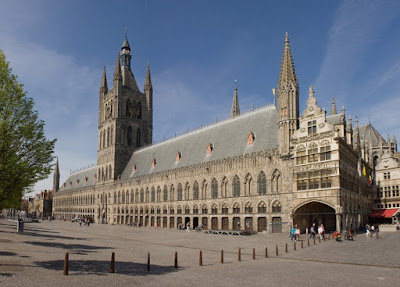
In Flanders Fields Museum. Image source

Tuesday, 17 October 2017

Résidence de France in Dublin - Open House Dublin 2017

On 14 October the French Ambassador to Ireland kindly opened his home on Ailesbury Road, the Résidence de France, to visitors for Open House Dublin 2017. I acted as a guide at the Résidence during the afternoon.
Photograph of the Résidence de France, 53 Ailesbury Road in 1930.

Originally known as Mytilene, 53 Ailesbury Road was built for the Bustard family in 1885. It was designed by Alfred Gresham Jones, who designed other buildings around Dublin city including the buildings that now contain the Davenport Hotel and the National Concert Hall. It sits on a plot of land about 2 acres in size. You can read more about the history of the house here.

The Bustard family put Mytilene up for sale in the 1920s. It was described in a newspaper advertisement as "a house built regardless of expense" and "a choice residence, leaving little to be desired, either in function, condition, or surroundings".

53 Ailesbury Road was acquired by the French government in 1930 for the Légation de France to the Irish Free State. It also housed the residence of the first French Minister to the Irish Free State, M. Charles Alphand. A chancery was located nearby for many years but was sold in recent years and a new Embassy was opened in Merrion Square in 2015. 53 Ailesbury Road continues to be the official residence of the French Ambassador to Ireland.

Friday, 19 December 2014

National Library of Ireland - Blog Post

I have just written another blog post on the official blog of the National Library of Ireland (NLI). It is about the Art Ó Bríain Papers - a collection of papers that I have been researching as part of my PhD research.

The previous blog post that I wrote on the NLI's official blog was about the French journalist, Simone Téry (1897-1967), who traveled to Ireland in the 1920s and wrote about it in the French press. It is available to read here.


Photograph of Art Ó Bríain (O'Brien) (1872-1949).

Art Ó Bríain was the London representative of the First Dáil in London from 1919 to 1922. If you are interested in finding out more about Art Ó Bríain, why not have a look at his entry on the Dictionary of Irish Biography, or take a look at the biography section of the Art Ó Bríain Papers collection list on the National Library of Ireland's website: http://www.nli.ie/pdfs/mss%20lists/150_OBriain.pdf

You could also check out the Documents on Irish Foreign Policy website, where you can easily search for documents written by, or to, O'Brien / Ó Bríain. All sorts of correspondence, including memos and letters written by and to Ó Bríain have been digitized and they give us an amazing insight into what was happening in Ireland at the time.


Photograph of the Manuscripts Department of the National Library of Ireland on Kildare Street, Dublin.

Monday, 14 October 2013

Irish Times Article - 14 October 2013

I have just written another Irish Times article. In it I speak about the strange and wonderful things that we come across when carrying out research in a library.

I recently found a lock of hair when going through the Art Ó Bríain papers in the National Library of Ireland. It belonged to Mrs Mac Swiney, the widow of the Lord Mayor of Cork who died on hunger strike in Brixton Prison. Ó Bríain was the spokesman for the First Dáil in London from 1919 to 1922. His job was to spread the word about Terence MacSwiney's hunger strike among newspaper people and news agencies in London. He received correspondence from people all over the world about MacSwiney.

The contents of the Art Ó Bríain papers are truly amazing. Have a look for yourself if you don't believe me: http://www.nli.ie/pdfs/mss%20lists/150_OBriain.pdf

Wednesday, 7 August 2013

NPHFI 2012 Annual Conference

I presented a paper at the 2012 NPHFI (Newspaper and Periodical History Forum of Ireland) conference, which took place in Kingston University, London on 16 & 17 November 2012. The conference theme was "Writing Against the Grain: Dissent, Minorities and the Press in History". A good number of speakers from Ireland, Europe and North America traveled to the conference. They covered a wide range of topics from regional and national Irish press history, to Romanian press history and to the Black press in the USA during the civil rights era. 

My paper dealt with how one French newspaper, L'Oeuvre, treated Ireland during the early 1920s, which was a very important period in Ireland's history. L'Oeuvre was a left-leaning daily newspaper run by Gustave Téry. He sent several reporters to Ireland at this time, including his daughter, Simone Téry. On her arrival in in Ireland in July 1921, Simone wasted no time in getting to the heart of the action, touring the country and interviewing many of the key people on the republican side as well as leaders of the British forces and unionist leaders in the north. Her interviews and her impressions of what was happening on the island featured on the front page of the newspaper for some time.

Along with the articles by Téry, L'Oeuvre also depicted what was happening in Ireland in cartoon form. Highlighting attacks on Irish civilians by Crown forces, such as the burning of Cork in December 1920, these witty little cartoons were able to cut through all the talk and tell the story as it was.

While in London, I was also able to carry out valuable research in the British Library in St. Pancras and the British Library Newspaper Collection in Colindale. My transport fare to London was covered by a UCC School of History postgraduate travel grant, for which I am very grateful.

Saturday, 15 December 2012

Research Trip, August 2011

In August 2011, during what could have been called a typical Irish summer, I hit the road to do some research. I visited the Armagh County Museum, which is in Armagh City in Northern Ireland (pictured below) and examined material related to George Russell (1867-1935). Russell, who was also known as AE, was a very interesting character who had many interests including the co-operative movement, poetry, journalism and painting. The staff were very helpful and I managed to get some invaluable quotations and references from the material they hold on AE.

I also visited the Model in Sligo Town. There was a great exhibition on at the time on paintings from the Celtic Revival period. Link to exhibition: http://themodel.ie/exhibitions/the-celtic-twilight

Photo of Sligo Town with Ben Bulben in the distance, covered in mist.