Showing posts with label UCC. Show all posts

Thursday, 9 October 2025

Visit to Cork Public Museum with a class

I am teaching an undergraduate module on 'France and the Great War' at the moment. It is a classroom based module but I thought it could be helpful for the students to look outside of the classroom for an alternative for one of our seminars - so I contacted the Cork Public Museum

The responsive to my initial approach to the museum was very positive and as a result of their work, we had a successful visit. It is great to actually see and feel items from that period (or authentic replicas) instead of just reading about them. 

 
Photograph of Cork Public Museum in Fitzgerald's Park. 

Thanks to the curator Mr Daniel Breen and education officer Ms Jessica Cull for welcoming us to the museum and presenting relevant items that they took out from storage for us.


Friday, 1 November 2024

PhD Conferring University College Cork

I was delighted to attend the College of Arts, Celtic Studies and Social Sciences conferring in University College Cork recently where I was conferred with a PhD. 

It was not an easy road and took a lot of effort but I am pleased to have reached this point. I could not have done it alone and therefore, would like to thank everyone who helped me to achieve this goal including friends, family, students, colleagues, supervisors and examiners.

 
Standing in the stone corridor of the north wing of the UCC quadrangle.
 
Receiving the PhD parchment from the President of UCC Prof. John O'Halloran at the conferring ceremony.

Friday, 19 April 2024

PhD Viva - 19 April 2024

Thank you to everyone who was involved with my PhD Viva today in University College Cork (UCC). I passed with minor corrections (which is a common outcome). 

Thank you to my supervisors (past and present) - Prof Grace Neville, Prof Dónal Hassett (Maynooth University) and Dr Donal Ó Drisceoil (UCC). Thank you also to the examiners - Dr Eamon Maher (TU Dublin) and Dr Kate Hodgson (UCC) who were thorough in their questioning and gave praise where it was due. Lastly, thanks to the independent Chair - Dr Aodh Quinlivan (UCC), for ensuring that it ran smoothly. 

 
Photograph following the Viva in UCC.

Wednesday, 1 March 2017

French cultural events taking place in Ireland in March 2017

Le Mois de la Francophonie takes place in venues around Ireland during the month of March 2017. Full details are available on their website: http://www.ambafrance-ie.org/The-Month-of-La-Francophonie-in-Ireland-2017-Programme

The 28th Cork French Film Festival will take place in Cork from Sunday 5th to Sunday 12th of March 2017. See their website for more information: http://corkfrenchfilmfestival.com/

The Franco-Irish Literary Festival will take place in various venues in Dublin from 30 March - 2 April 2017. 'Style & Stylistics' is the 2017 theme. Full details are available on their website: http://www.francoirishliteraryfestival.com/
The March Newsletter of the French Embassy's Cultural Service lists many other events taking place in Ireland in March.

Sunday, 23 November 2014

NPHFI 2014 Conference - University College Cork

The 2014 Annual Conference of the Newspaper and Periodical History Forum of Ireland NPHFI took place in University College Cork (UCC) on 21 & 22 November 2014. As Secretary of the Forum, I had a bit of work to do in organising the conference.


The conference was opened by the NPHFI Chairman, Dr Mark O'Brien and delegates were welcomed to UCC by the Head of the UCC School of History, Prof David Ryan. The Chairman of the Irish Examiner newspaper, Mr Tom Crosbie, also welcomed the conference delegates to Cork.

The conference theme was: 'Home thoughts from abroad: History, the Press and Diaspora'. I suppose diaspora is something that Irish people know a great deal about, with generations of Irish having been forced to move abroad in search of work and a better life.

Speakers came from universities in Ireland, UK, USA and Australia to present papers on how the link between Ireland and the Irish around the world was maintained over generations by means of the newspaper and the periodical.

The plenary speech was delivered by Prof. Donal McCracken, University of KwaZulu-Natal, South Africa, who spoke about Irish edited newspaper in South Africa. There's a short piece on the conference on the Evening Echo website here.

Details of the 2015 conference will be announced soon on the NPHFI website http://newspapersperiodicals.org/ and Facebook page https://www.facebook.com/NPHistoryForum

Saturday, 3 December 2011

The Boolean Journal article

I wrote an article explaining my research for the University College Cork (UCC) post graduate journal, known as The Boolean. This second volume of the journal was launched in October 2011 and is named after George Boole - the first Professor of Mathematics in UCC and the inventor of Boolean logic. As that venerable source of information, Wikipedia states: "Boolean logic is the basis of modern digital computer logic. Boole is regarded in hindsight as a founder of the field of computer science".

This is a link to the article -

http://publish.ucc.ie/boolean/2011/00/OHanlon/37/en

Please have a look and tell me what you think.

Tuesday, 12 July 2011

UCC Doctoral Showcase 2011


The UCC Doctoral Showcase took place on 21 June 2011. The showcase is a relatively new concept whereby PhD students explain their research to a public, non-specialist audience. I applied to take part in it and was chosen to go through to the final on 21 June 2011.

There were three categories in the showcase:

- the poster competition, where students presented their research on a poster.

- the three minute thesis, where students presented their research in a three minute presentation, using whatever props they thought was necessary and only one powerpoint slide.

- the ten minute thesis, where students presented their research in a ten minute presentation, using props and as many powerpoint slides as they wanted.

As a first year PhD student I could apply for the poster competition or the three minute thesis. I decided to apply for the three minute thesis. Three judges evaluated the entrants and they awarded a first and second prize in each category. I was not successful on this occasion, but will keep practicing my presentation skills. I think it's a valuable skill to be able to describe your research (or anything for that matter) in a succinct and clear manner.

The Showcase brochure.

Sunday, 10 April 2011

'Taking Risks' - Azouz Begag in UCC


The French writer, sociologist and sometimes politician, Azouz Begag was in University College Cork on Friday 8 April 2011. He was invited to Cork to launch France, Ireland and Rebellion, Proceedings of the 5th AFIS Conference, (2011), a book based on conference papers from the AFIS (Association of Franco Irish Studies) conference that was held in 2009.

In the morning, Mr Begag read excerpts from some of his work and later delivered a lecture on immigration. He said that this was his third visit to Ireland and his first to Cork. He began by saying that when he thinks of Ireland he thinks of his father, who had travelled from Algeria to France in search of work. He said that the Irish (like the Algerians) who travelled abroad to look for work went with the myth that they would return home in their luggage and that this gave them strength to travel and sustained them when outside of Ireland or Algeria.

I had read his book about his life growing up in a shanty town in Lyon and his book about being the Minister for Equal Opportunities in Dominique de Villepin's goverment. In Un Mouton dans la baignoire , Begag describes how stressful political life can be and how a rift grew between him and Nicolas Sarkozy over something that was said and misinterpreted. He has written fiction and non-fiction and he said that he was inspired to become a writer when he realised that his father couldn't sign his own name.

The power of LANGUAGE
From listening to Mr Begag speaking in Cork, I learned that he sees language as a valuable weapon in life. Immigrants can use it like a passport to help them to advance themselves in the country in which they're living. He said that verlan, the slang that many young people use in France is more of handicap to them than anything else. It acts like a barrier that locks them up and keeps them segregated from the mainstream.

I called this post Taking risks, because Mr Begag said that he likes it when people who are learning a foreign language take risks with language and try to speak the foreign language even if they are not very very good at it. It shows that they have courage and are willing to take risks, and don't mind looking foolish, as we invariably feel when we try to communicate in a language that isn't our mother tongue.

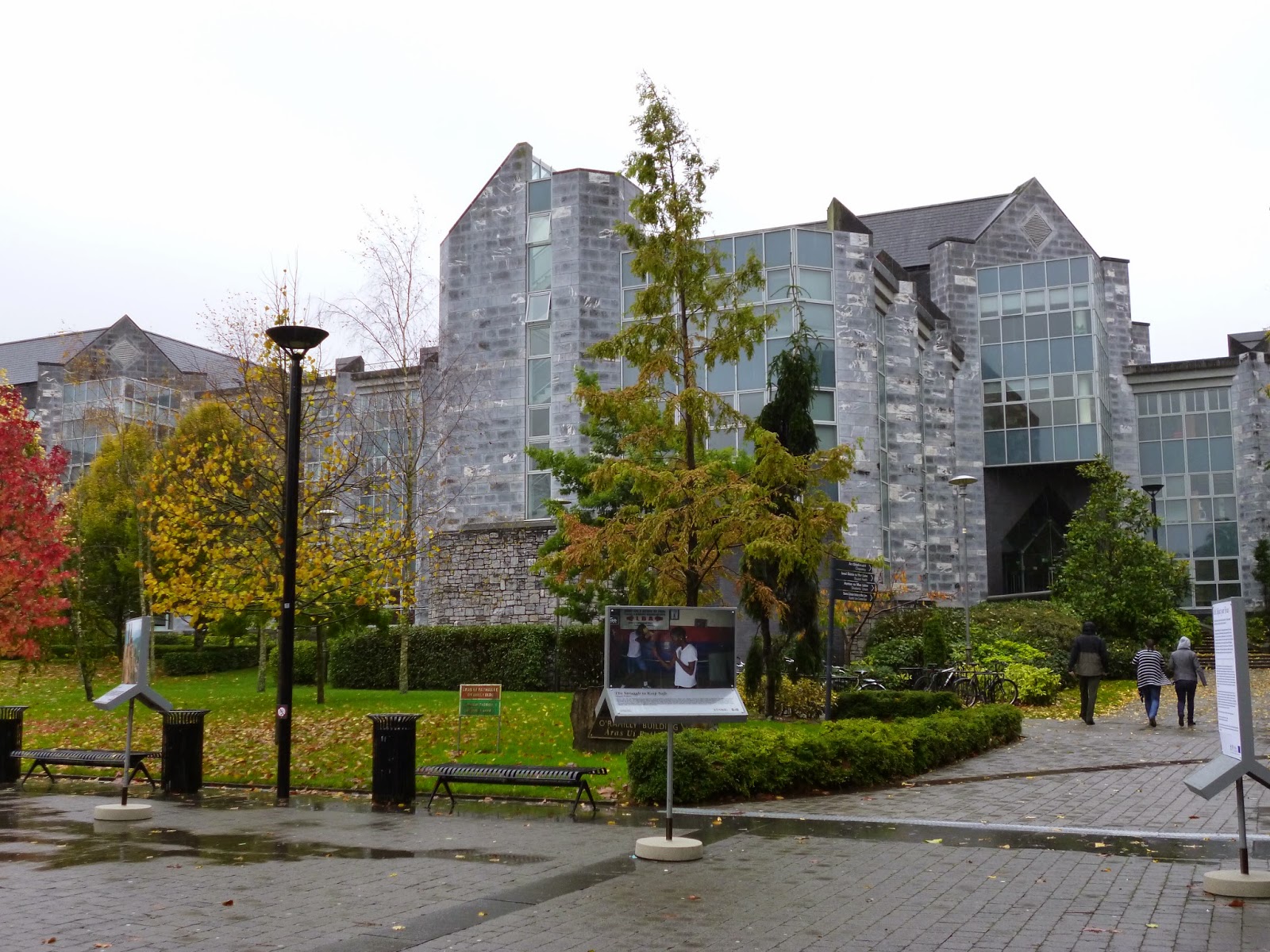
The picture shows Mr Begag reading from his book Le Gone du Chaba in the O'Rahilly Building in UCC. The book deals with his life growing up in a shanty town in the outskirts of Lyon. He describes the deprivation that he and his poor family experienced and his integration into the French society through the education system. He said that the book is still very relevant today, 24 years after it was published, because of the profound sociological lessons to be learned from it.

Saturday, 9 April 2011

ADEFFI Post Graduate Symposium in UCC


The ADEFFI (l'Association des Études françaises et francophones en Irlande)
Post Graduate Symposium took place in University College Cork on Saturday 2 April 2011. It provided post graduate students from universities and colleges in Ireland who are involved in the area of French studies to come together and present their work before their peers.

I was one of the co organisers of the symposium and I also presented a paper on the day. My paper dealt with the friendship between the journalist, painter and poet AE, or George Russell to give him his real name and Simone Téry (one of the French journalists whose work I am examining as part of my PhD). Ten post graduate students, including students from University College Cork, Trinity College Dublin, two students from universities in the UK and a student from a French university presented papers on the day. The wide range of topics covered included Beckett, Baudelaire, Nerval, Perec, Rwanda's genocide in the 1990s and French involvement in Rhodesia's push for independence in the 1980s.

The picture at the top of the post is of some of the symposium participants in the UCC campus.

Monday, 7 March 2011

French film director Agnès Varda in UCC


The French film director Agnès Varda visited University College Cork (UCC) today Monday 7 March 2011. She spoke to over 100 of the university's staff and students for about an hour and a half about her life and her movies.
The annual Cork French Film Festival is taking place at the moment and many of Varda's famous films are among the main attractions of the festival. When people hear her name, they instantly associate her with the Nouvelle Vague movement in cinema. She said that she was pleased to have been invited to Cork where three different areas of her work were being recognised: her work as a visual artist, a filmmaker and a photographer. "I don't want to represent French cinema, I want to represent myself", said Varda at the beginning of her talk.
She spoke about her introduction into the whole movie making business. The French theatre and film actor, Jean Vilar, had asked her to take some photographs on a movie set. This work with the camera inspired her and she went on to make her own movie, La Pointe Courte (1954). I've seen this and really liked it. It's a black and white film, set in a French fishing town and follows the lives and loves of some of the locals. It was filmed in Sète on the Mediterranean coast and looks lovely. She said it was very very hot during filming and that it was all done along co-operative lines - everyone was equal and they only had very basic facilities.
Varda mentioned Michel de Montaigne's essays as an inspiration to her in her work. She said that Montaigne created his essays in order to be remembered and that she is doing her film work so that she will be remembered and also that her family will know her. Another inspiration for Varda seems to be paintings. Firstly, she mentioned Rembrandt, who did a lot of self portraits, but she didn't think he was so much painting himself because he loved himself, but he painted himself because he wanted to be remembered and also to show the changes in his appearance over the years.
Another one of Varda's early films - Cléo de 5 à 7 (1962), tells the story of a beautiful young singer who fears death by cancer. Varda said that for this film she was inspired by a famous painting showing a blond nude woman surrounded by a skelatal figure (death). I didn't catch the name of the artist, but she said that his paintings are on show in Munich and Vienna.
A couple of years ago I saw Varda's film Daguerreotypes (1976) where she introduces the audience to the inhabitants of the rue Daguerre, where she lives in Paris. I liked the film.
It was very interesting to hear this legend speaking about herself and her work and I am happy that I went along to hear her.