Showing posts with label Irish Studies. Show all posts

Wednesday, 9 September 2026

Book Launch - Dublin 6 October 2026


Please join us to launch Freedom of Speech in the Press in Times of Conflict: Historical Perspectives from Ireland and Europe 
in the Museum of Literature Ireland (MoLI), 86 St. Stephen's Green, Dublin 2 at 6pm on Tuesday 6 October 2026.

Edited by Prof Richard C. Allen, Felix M. Larkin, Dr Oliver O'Hanlon and Prof Aoife Whelan, the book will be launched by the historian and broadcaster Dr David McCullagh.

The book came about following a conference organised by the Newspaper and Periodical History Forum of Ireland (NPHFI). The book's table of contents is reproduced below and you can order a copy of the book on the publisher's (Peter Lang) website. It is the latest in Peter Lang's series on Studies in Franco-Irish Relations. Thanks to Eamon Maher (Series Editor) and Anthony Mason (Peter Lang) for their assistance during the publishing process.

Register here to attend the book launch on Tuesday 6 October at 6pm.


Friday, 5 June 2026

Book chapter published - Freedom of Speech in the Press in Times of Conflict

Delighted to say that I received a copy of the book Freedom of Speech in the Press in Times of Conflict: Historical Perspectives from Ireland and Europe (Oxford: Peter Lang, 2026), ed. by Richard C. Allen, Felix M. Larkin, Oliver O'Hanlon and Aoife Whelan. Details of this book are available on the publisher's website here.

 
Front cover of Freedom of Speech in the Press in Times of Conflict

My chapter (pp. 55-77) examines the work of Art O'Brien, who was the first Dáil's publicity man in London during the Irish War of Independence. He was responsible for disseminating the message of the 1st Dáil (whose term ran from January 1919 to August 1921) to the foreign press corps based in London and the outside world. He was in constant contact with the Dáil's Publicity Department in Dublin and the various heads of that Department.

The 1st Dáil met for the first time in Dublin's Mansion House before it was outlawed in September 1919. It had to meet in secret thereafter. As such, O'Brien had to be extremely careful when carrying out his mission. You can read more about O'Brien in his entry in the Dictionary of Irish Biography or if you want to go further, I would recommend the biography by Mary MacDiarmada Art O'Brien and Irish Nationalism in London, 1900-25.  


Table of contents.

As you can see from the table of contents reproduced above, the book covers a range of subjects in Ireland, France, Spain and Germany at different times of conflict. I am grateful to my fellow editors, Richard Allen, Felix Larkin and Aoife Whelan, and to the other contributors for all their hard work in bringing this volume to fruition

Andreas Strobl

Michael Foley

Claire Dubois

Claire Guerin

Alan McCarthy +

William Burton

Conor Campbell

Karine Deslandes 

+ Dr Alan McCarthy - sadly Alan did not live to see this volume in print. There is a tribute to Alan on the UCC School of History website, you can read it here. He was a great scholar and a really nice human being. He will be missed.
 

Saturday, 28 February 2026

More Irish-themed covers of Le Petit Journal - Abbey Theatre Riot Feb 1926

I have previously written here about Irish-themed covers of the French illustrated periodical Le Petit Journal illustré. Another one to add to the list was published on this day (28 February) in 1926. It concerns the Abbey Theatre riot that took place in the Abbey Theatre in Dublin on 11 February 1926 when some audience members reacted angrily to a staging of Seán O'Casey's play The Plough and the Stars. You can find out more about the incident here.

 
Back cover of Le Petit Journal 28 February 1926. Image source
 
Page 2, Le Petit Journal 28 February 1926. Image source.  

The illustration of the riot was accompanied by a short description of what happened on the night. It was, according to the newspaper, 'something that could only take place in Ireland'. 'Things came to blows and the women grabbed each other's hair', it went on. 

W.B. Yeats tried in vain to separate the fighters and address the crowd but his efforts failed. The theatre was eventually cleared and closed. According to the newspaper, 'with the tenacity that marks the Celtic race, the directors of the Abbey and their actors claim that they will go on staging the play as they had planned'. 

Wednesday, 25 February 2026

WW1 Memorial Cross in Ieper/Ypres Belgium - RTÉ Brainstorm article

A tall stone Celtic Cross in the Belgian city of Ieper (Ypres) commemorates men from Cork in Ireland who died there during the First World War. I have just written a short article about the history of the cross for the RTÉ Brainstorm website. Read it here.

 
Photograph of the memorial with the cathedral in the background.

Ieper, known as Ypres during the War, was held by the forces of the Allied Powers right throughout the War. The cost of holding this strategic location was high for the Allies as well as the Central Powers (Germany, Austria-Hungary and the Ottoman Empire). Many hundreds of thousands died during the Three Battles of Ypres in 1914, 1915 and 1917.  

 
Photograph of the memorial showing a carving to represent the crest of Munster (three crowns) with some Celtic knot motif on the bottom.

After the War, Ieper was seen as 'holy ground' by ex-servicemen on account of all the lives lost there during the War and the near utter destruction of the town. I have previously written about the destruction and rebuilding of the town here. The memorial cross was unveiled in 1924 and by that stage, Ireland had gained its independence from Britain. 

The sacrifice of the Irishmen who fought in the British army during the War was remembered by their family and the community they came from. However, with independence came a fresh perspective on the Irish who fought and died during the War. 

 
Photograph showing the detailed carving of the Celtic motif on the shaft of the cross.

This article by Fionnuala Walsh on the 1914-1918 Online Encyclopedia covers how the attitude of Irish people to the War evolved over the years. This article by Edward Madigan deals with how the centenary of the War was marked in Ireland and how this provided a chance to look back on that period with a more objective outlook. The renewed interest in the story of the Irishmen who fought in the War that was prompted by events such as the Decade of Centenaries can be seen in the renewed links between Cork City Council and Ieper City Council that I mention in the Brainstorm piece. 

Monday, 5 May 2025

An Irish Diary on Etiennette Beuque

Etiennette Beuque (d. 1949) was fascinated with Ireland. The French writer became interested in Ireland and Irish history around the time of the Easter Rising and the War of Independence. She ultimately became very attached to Eamon de Valera's republican politics and wanted her compatriots to share her knowledge of Ireland and Irish history. I have just written an Irish Diary in today's Irish Times newspaper about Beuque and her interest in Ireland. Read it here.

Pour L'Irlande by Etiennette Beuque from the Boole Library Special Collections.

As mentioned in my article, Beuque wrote several books in French about Ireland (including Pour L'Irlande above). Her non-fictions books focused on Irish history, particularly what happened to Ireland under British rule and also the independence movement. Her fiction novels used the Easter Rising as a focal point and they demonstrate her partiality for the republicans. 

Beuque was an interesting writer. She was not a journalist or a professional writer but she managed to write a great deal about her favourite subject of Ireland. Historian Pierre Joannon called her 'a pro-Irish fanatic'. Beuque planned to write a book on Terence MacSwiney (1879-1920), the lord mayor of Cork who died in prison in England, but gave up on the idea after the Second World War. She said that she decided not to write it in recognition for the assistance that Britain gave to France during the war. If you have any information on Etiennette Beuque, please let me know.


Friday, 28 March 2025

SOFEIR conference in University College Cork (UCC)

The 2025 SOFEIR (Société Française d'Études Irlandaises / French Society of Irish Studies) conference was held in University College Cork on 21-22 March 2025. SOFEIR was founded in Rennes in 1981 and brings together academics who work in the broad interdisciplinary field of Irish studies in France. This was (I think) the second time that the conference was held in Ireland.

The theme for the conference was 'Ireland and Transnational Solidarities'. Academics and researchers came from Ireland, France and the UK to present papers on various topics from Palestine, Algeria and India to herbal medicine, Irish literature and surfing. 

 
Getting the Dr Dora Allman room in the Hub ready for the conference.

I delivered a paper on Etiennette Beuque (d. 1949), a Frenchwoman who wrote numerous books on Ireland in the 1920s and 1930s. She became interested in Ireland around the time of the push for Irish independence 100 years ago. Her books focused on Irish history and contemporary Irish politics. She also wrote poetry and a couple of books of fiction based on Ireland (particularly the Terence MacSwiney hunger strike and the Easter Rising).


The photograph above shows a packed audience listening to Prof Dónal Hassett deliver a keynote speech on the experience of Irish peasants who were sent to set up home in French controlled Algeria in the 1800s. It ended in disaster and the Irish people that went there eventually made their way back to Ireland.

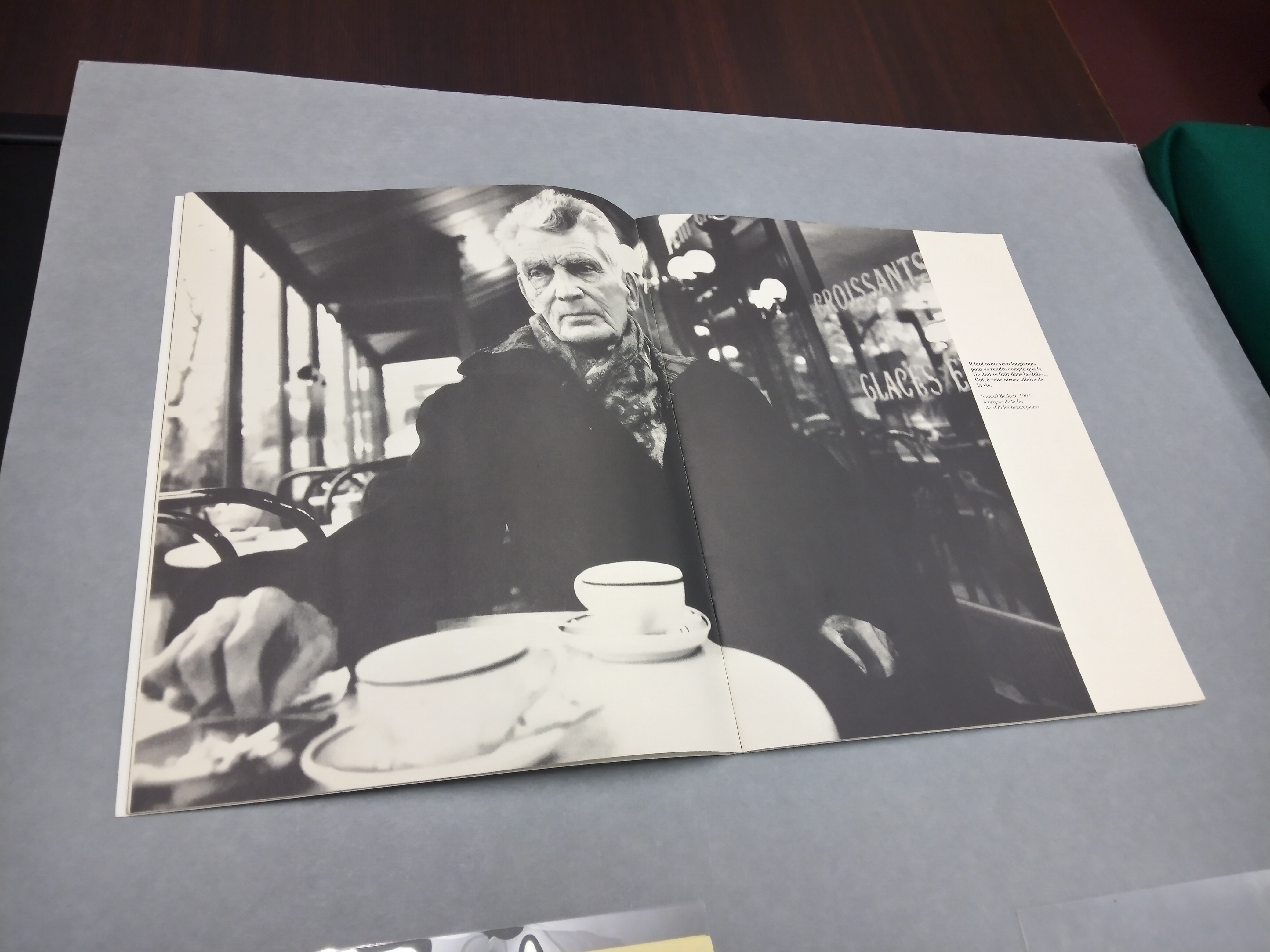
A library exhibition was organised by Prof Patrick O'Donovan (Dept. of French, UCC) and Luke Watson (School of History, UCC) to run alongside the conference in the UCC Boole Library. Entitled 'Ireland and France: Transnational Nations', conference attendees were able to view the exhibition during the conference. It included a wide range of exhibits from the library's holdings. Below are some examples of the kind of material (a French map of Ireland and a photograph of Samuel Beckett in Paris) that was on display as part of the exhibition.

Monday, 30 October 2023

Irish themed covers of Le Petit Journal illustré

Every Monday morning for the last number of years, I have been tweeting (posting) the front page of the weekly French illustrated periodical Le Petit Journal illustré from 100 years ago. Occasionally, events in Ireland made the front page or the back page (they both contained a drawn image of whatever was making the news in France or around the world that week). 

I have listed below some of the covers relating to an Irish story. The first is from September 1920 and deals with the death of the Lord Mayor of Cork, Terence MacSwiney, in October 1920 after 74 days on hunger strike in Brixton prison. 

The last cover also refers to MacSwiney, in a way, as it shows prisoners in Mountjoy prison in Dublin on hunger strike in the aftermath of the Irish Civil War. The caption reads A l'exemple du Maire de Cork [following the Mayor of Cork's example]. It says that 424 prisoners have been on hunger strike since 14 October 1923. The images come from Gallica - the digital library of the Bibliothèque nationale de France.

 
Le Martyr Irlandais - Death of Terence MacSwiney. 19 September 1920. Source

Les Évéments d'Irlande - Irish War of Independence. 5 December 1920. Source

 
Le Sous-Marin Fantôme - Irish War of Independence. 3 July 1921. Source
 
Un assassinat politique - Assassination of Henry Wilson. 2 July 1922. Source
 
Les convulsions sanglantes de l'Irlande - Assassination of Michael Collins. 3 September 1922. Source

A l'exemple du Maire de Cork - Hunger strike in Mountjoy prison. 28 October 1923. Source

Sunday, 15 October 2023

Flanders Fields Bursary Scheme 2023

This is a short description of the time I spent in Belgium in September 2023 on the Flanders Fields Bursary Scheme which is run by the In Flanders Fields Museum in Ieper (Ypres) and the Embassy of Ireland to Belgium. I have already written an Irishman's Diary in the Irish Times newspaper (see here) but I thought I'd give a little extra information about it here.

I saw the Flanders Fields Bursary advertised online in September 2022 and applied for it. This is the announcement that was made at the time. I was delighted when I was told that my application was chosen from among those who applied. I was given a choice of going to Ieper (Ypres) in either May or September to work on the research project and I chose September, thinking that the temperature might be a little cooler by that stage.

 
View of the Research Center at the In Flanders Fields Museum. Sept. 2023.

As it turned out, the weather was still very good in September and the temperature was mostly around 20-30°C. During the three weeks of the project, myself and another student from Ireland, Eilís Campbell, worked in the Research Center of the In Flanders Fields Museum in Ieper. 

Our job was to fill in the blanks of the Irish entries on the Names List which is a list of all those who died in Belgium due to the First World War (both military and civilian). We had a range of sources to draw on to help us in our research including British army military records, Irish and British census information, soldiers' wills and church records.

 
Visit to a Commonwealth War Graves Commission cemetery containing the graves of Irish who served in the British army. Sept. 2023.

During our time in Belgium, we also visited some sites near Ieper that had a connection with Ireland. This included the Island of Ireland Peace Park at Messines, which commemorates the dead of the three Irish divisions who fought in the War; [36th (Ulster) Division; 10th (Irish) Division and the 16th (Irish) Division].

We visited cemeteries of the Commonwealth War Graves Commission that contained the graves of Irish men who served in the British army. We were brought to the graves of the Co. Meath-born poet, Francis Ledwidge (1887-1917), who was killed in Boezinge near Ieper and the Irish nationalist politician, William Redmond (1861-1917), who was killed in Loker. We also visited the Passchendaele Museum in Zonnebeke.

As the Bursary scheme is organised in conjunction with the Embassy of Ireland to Belgium, we were invited to meet the Irish Ambassador and discuss our work on the project. It was a very enjoyable and rewarding experience to work on this project. I was able to put my research skills to good use and learned so much about the history of the First World War and the part played by Irish men in the War.

I want to thank all of those who helped me during the project to make it such an enjoyable and worthwhile experience - particularly the Embassy staff and the staff and volunteers at the In Flanders Fields Museum. Thank you all and I hope that the Bursary scheme continues for the years to come.

 
Meeting the Irish Ambassador to Belgium (2nd from left) (Mr Kevin Conmy) at the Embassy of Ireland to Belgium. Sept. 2023. Also pictured Ms. Eilís Campbell (2nd from right) (Ulster University) and Ms. Erica Lee (right) (Deputy Head of Mission at the Embassy of Ireland to Belgium).

Friday, 18 August 2023

Bursary award to carry out research in Belgium (In Flanders Fields Museum).

I am delighted to announce that I have been selected as a recipient of a bursary to carry out research in Belgium. Organised in conjunction with the Embassy of Ireland in Brussels, I will travel to Ieper / Ypres and conduct research into Irish involvement in the First World War at the In Flanders Fields Museum. I will post more information about the project soon. I am grateful to the Irish Embassy and the Museum for selecting my application from the large number submitted.

https://blogger.googleusercontent.com/img/b/R29vZ2xl/AVvXsEjnZYcCWmKQGyezKsbYh33Ib7hUBw0EuCbHB3LcOWtr8xtvUp6myZtwwMi94WJqWzjIseoTAWr8hK_i0j56fn41H0TjQZgZ9wHHI4cIYtXRDj3owa_lq6lNyZxovy1Ju6oh1Qo5xRYA34vy/s1600/Ieper+Lakenhal.jpg 

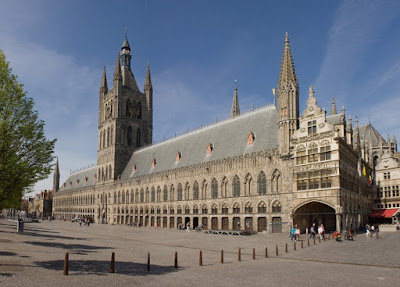
In Flanders Fields Museum. Image source

Monday, 9 January 2023

George Lansbury (grandfather of Angela) - An Irishman's Diary

The grandfather of the recently deceased actor of stage and screen, Angela Lansbury (1925-2022), was a long-serving British Labour Party MP who led the Party for a time in the early 1930s.

His name was George Lansbury (1859-1940) and I have just written an Irishman's Diary in the Irish Times about him and his commitment to bringing about better relations between Britain and Ireland. Read my newspaper article here.

https://collectionimages.npg.org.uk/large/mw68864/George-Lansbury.jpg 

Portrait of George Lansbury from the National Portrait Gallery. Image source

Lansbury was a committed Socialist who was concerned with worker's rights, women's rights, peace, and local democracy, among other things.

As I mention in my article, George Lansbury was described by Hannah Sheehy Skeffington as a "faithful friend of Ireland". This was on account of the ways he tried to help foster better relations between Ireland and Britain during his time as an MP.

If you want to find out more about George Lansbury, you can look at his papers, which are held in the LSE (see here). The website and Twitter account of the George Lansbury Memorial Trust also contain more information about the man.

Sunday, 21 August 2022

Michael Collins in the French press - Aug. 1922

Below is a selection of front page articles from the French press on the death of Michael Collins (1890-1922) on 22 August 1922. It took time for the news to reach the Paris newsrooms so they are all from 24 August 1922. Most of the papers got their reports from news agencies or their London correspondent.


'Yet another crime in Ireland - Mr Michael Collins (head of the Irish Provisional Government) has been killed'. Le Radical, 24 Aug 1922. Source


'Mr Michael Collins (head of the Irish Provisional Government) was killed by the rebels in an ambush'. Le Petit Parisien, 24 Aug 1922. Source


'Michael Collins (head of Ireland's Provisional Government) has been killed in an ambush'. L'Oeuvre, 24 Aug 1922. Source


'Michael Collins, head of the Irish Free State, was killed by the insurgents in an ambush, his former brothers in arms'. Le Journal, 24 Aug 1922. Source


'General Michael Collins head of the Free State was killed in an ambush'. La Lanterne, 24 Aug 1922. Source 


'Irish Civil War. Mr Michael Collins, head of the Provisional Government has been killed'. La Liberté, 24 Aug 1922. Source


'General Michael Collins, prime minister of the Free State, is killed by the insurgents'. Le Matin, 24 Aug 1922. Source


'Mr Michael Collins dies in an ambush'. L'Humanité, 24 Aug 1922. Source


'The new Irish leader is killed in an ambush'. L'Instransigeant, 24 Aug 1922. Source


'After Mr Griffith, Mr Collins - Government leader killed'. La Croix, 24 Aug 1922. Source


'The President of the Irish Republic is killed in an ambush'. L'Echo d'Alger, 24 Aug 1922. Source 


'Mr Collins, head of the Irish government, is killed in an ambush'. L'Echo de Paris, 24 Aug 1922. Source 


'Mr Michael Collins has been killed'. Excelsior, 24 Aug 1922. Source