Monday, 30 October 2023

Irish themed covers of Le Petit Journal illustré

Every Monday morning for the last number of years, I have been tweeting (posting) the front page of the weekly French illustrated periodical Le Petit Journal illustré from 100 years ago. Occasionally, events in Ireland made the front page or the back page (they both contained a drawn image of whatever was making the news in France or around the world that week). 

I have listed below some of the covers relating to an Irish story. The first is from September 1920 and deals with the death of the Lord Mayor of Cork, Terence MacSwiney, in October 1920 after 74 days on hunger strike in Brixton prison. 

The last cover also refers to MacSwiney, in a way, as it shows prisoners in Mountjoy prison in Dublin on hunger strike in the aftermath of the Irish Civil War. The caption reads A l'exemple du Maire de Cork [following the Mayor of Cork's example]. It says that 424 prisoners have been on hunger strike since 14 October 1923. The images come from Gallica - the digital library of the Bibliothèque nationale de France.

 
Le Martyr Irlandais - Death of Terence MacSwiney. 19 September 1920. Source

Les Évéments d'Irlande - Irish War of Independence. 5 December 1920. Source

 
Le Sous-Marin Fantôme - Irish War of Independence. 3 July 1921. Source
 
Un assassinat politique - Assassination of Henry Wilson. 2 July 1922. Source
 
Les convulsions sanglantes de l'Irlande - Assassination of Michael Collins. 3 September 1922. Source

A l'exemple du Maire de Cork - Hunger strike in Mountjoy prison. 28 October 1923. Source

Sunday, 15 October 2023

Flanders Fields Bursary Scheme 2023

This is a short description of the time I spent in Belgium in September 2023 on the Flanders Fields Bursary Scheme which is run by the In Flanders Fields Museum in Ieper (Ypres) and the Embassy of Ireland to Belgium. I have already written an Irishman's Diary in the Irish Times newspaper (see here) but I thought I'd give a little extra information about it here.

I saw the Flanders Fields Bursary advertised online in September 2022 and applied for it. This is the announcement that was made at the time. I was delighted when I was told that my application was chosen from among those who applied. I was given a choice of going to Ieper (Ypres) in either May or September to work on the research project and I chose September, thinking that the temperature might be a little cooler by that stage.

 
View of the Research Center at the In Flanders Fields Museum. Sept. 2023.

As it turned out, the weather was still very good in September and the temperature was mostly around 20-30°C. During the three weeks of the project, myself and another student from Ireland, Eilís Campbell, worked in the Research Center of the In Flanders Fields Museum in Ieper. 

Our job was to fill in the blanks of the Irish entries on the Names List which is a list of all those who died in Belgium due to the First World War (both military and civilian). We had a range of sources to draw on to help us in our research including British army military records, Irish and British census information, soldiers' wills and church records.

 
Visit to a Commonwealth War Graves Commission cemetery containing the graves of Irish who served in the British army. Sept. 2023.

During our time in Belgium, we also visited some sites near Ieper that had a connection with Ireland. This included the Island of Ireland Peace Park at Messines, which commemorates the dead of the three Irish divisions who fought in the War; [36th (Ulster) Division; 10th (Irish) Division and the 16th (Irish) Division].

We visited cemeteries of the Commonwealth War Graves Commission that contained the graves of Irish men who served in the British army. We were brought to the graves of the Co. Meath-born poet, Francis Ledwidge (1887-1917), who was killed in Boezinge near Ieper and the Irish nationalist politician, William Redmond (1861-1917), who was killed in Loker. We also visited the Passchendaele Museum in Zonnebeke.

As the Bursary scheme is organised in conjunction with the Embassy of Ireland to Belgium, we were invited to meet the Irish Ambassador and discuss our work on the project. It was a very enjoyable and rewarding experience to work on this project. I was able to put my research skills to good use and learned so much about the history of the First World War and the part played by Irish men in the War.

I want to thank all of those who helped me during the project to make it such an enjoyable and worthwhile experience - particularly the Embassy staff and the staff and volunteers at the In Flanders Fields Museum. Thank you all and I hope that the Bursary scheme continues for the years to come.

 
Meeting the Irish Ambassador to Belgium (2nd from left) (Mr Kevin Conmy) at the Embassy of Ireland to Belgium. Sept. 2023. Also pictured Ms. Eilís Campbell (2nd from right) (Ulster University) and Ms. Erica Lee (right) (Deputy Head of Mission at the Embassy of Ireland to Belgium).

Friday, 13 October 2023

RTÉ Brainstorm article on the Original All Black - Dave Gallaher (1873-1917)

The captain of the New Zealand rugby team known as the 'Original All Blacks' was Dave Gallaher (1873-1917). He was born in Ramelton, County Donegal and emigrated with his family to New Zealand in 1878. I have just written a short article about him for the RTÉ Brainstorm website. Read it here.

 
Photograph of Dave Gallaher from 1905. Image source.

As I mention in the RTÉ Brainstorm article, Gallaher has an entry in both the Dictionary of Irish Biography (DIB) and its New Zealand equivalent - the Dictionary of New Zealand Biography. You can read them here and here. He began playing rugby for the Ponsonby Rugby Football Club after the family moved to Auckland a couple of years after his mother's death in 1887.

 
Dave Gallaher in his Ponsonby rugby jersey. Image source.

The first match between Ireland and the All Blacks took place at Lansdowne Road in Dublin on November 25th 1905. You can read an account of the match from the Maitland Daily Mercury here. They seem to have got their information from the Daily Mail but it is still interesting to read what commentators thought of the match at the time. He managed to visit his native Donegal during the trip to Ireland. I wonder what the locals made of his strange accent and what he thought of their distinctive accent.

When he heard that his younger brother, Douglas Wallace Gallaher, was killed in action in France during the Battle of the Somme in June 1916, Dave enlisted in the New Zealand Expeditionary Force. He was one of over 120,000 New Zealanders to enlist and one of over 100,000 New Zealanders to serve overseas during the First World War.

 
Photograph of Corporal Dave Gallaher in uniform. Image source.

Dave Gallaher was one of 13 former All Blacks to lose their lives during the War. Altogether three Gallaher siblings perished during the conflict. Along with Douglas and Dave, another brother, Henry, was killed by shellfire in April 1918. Sadly, some 18,000 New Zealanders lost their lives on the Western Front during the War. You can learn more about New Zealand's contribution here.

 
Dave Gallaher's gravestone in Nine Elms British Cemetery, Poperinge. Image source.
 
If you would like to find out more about Dave Gallaher and the Original All Blacks, there is a 44 minute film here on YouTube called 'Dave Gallaher - the Original All Black'. It was made by Letterkenny RFC, whose ground was renamed 'Dave Gallaher Park' in 1999.

Thursday, 28 September 2023

Ambassador's letter - "the only scheme of its kind"

I was please to see this letter from the Irish Ambassador in Brussels. It appeared in the Irish Times following my Irishman's Diary in the Irish Times about the three weeks I spent at the In Flanders Fields Museum in Ieper (Ypres) Belgium in September 2023. Read it here

Thank you very much Mr Ambassador. I will write a blog post about my experience on the bursary scheme soon.


Monday, 25 September 2023

An Irishman's Diary on Ireland's Memorial Records and the Names List

I have just written an Irishman's Diary in today's Irish Times newspaper about the project I was working on for the last few weeks at the In Flanders Fields Museum in Ieper (Ypres) Belgium. Read it here.

 
Bookcase at In Flanders Fields Museum which contains the eight volumes of Ireland's Memorial Records.
 
The In Flanders Fields Museum Bursary scheme is run by the In Flanders Fields Museum and is supported by the Irish Embassy in Brussels and the Department of Tourism, Culture, Arts, Gaeltacht, Sport and Media. The idea is to fill in the gaps in the information concerning Irishmen who fought in the British army during the First World War or for British-born men who fought in Irish regiments of the British army during the War. 
 
In the past, records of these men was not as good as they could have been - names could have been spelled incorrectly or important information such as date of birth, place of birth, next of kin, was missing. You can search the Names List (Namenlijst) which contains the name of over 550,000 people (military and civilian) here.
 
 
First page in Ireland's Memorial Records. There are illustrations like these by Harry Clarke around the border of every page.

Tuesday, 29 August 2023

An Irishman's Diary on the Cork International Exhibition 1902/03

The Cork International Exhibition was a massive undertaking and turned out to be a great success. Opened on 1 May 1902, it attracted nearly 2 million visitors. I have just written an Irishman's Diary about the Exhibition in the Irish Times newspaper. Read it here.

 
Exhibition catalogue, on display in the Cork Public Museum.

Over 500 exhibitors showed off their wares at the Exhibition when it opened in 1902. As I say in the article, it was deemed to have been such a success that it was decided to re-open it in May of the following year as the Greater Cork International Exhibition. 

Most of the buildings and structures erected for the Exhibition were taken down immediately following the end of the 1903 Exhibition or in the decades following. Two buildings that have remained are the Shrubberies House (now Cork Public Museum), which was used as an administration center during the Exhibition and the small President and Lord Mayor's Pavilion (now used as an art gallery).

 
The Shrubberies (Cork Public Museum)


The President and Lord Mayor's Pavilion (now art gallery).
 
The previous exhibitions to take place in Cork were on a much smaller scale. The First Irish Industrial Exhibition Cork 1852 took place in a building where the Cork City Hall now stands. Here you can view a map of Cork from the time to get an idea of what the city looked like back then.

If you are interested in the 1883 Irish Industrial and Fine Art Exhibition that took place in Cork, you can view and download the catalogue here from the Cork Public Museum.

Friday, 18 August 2023

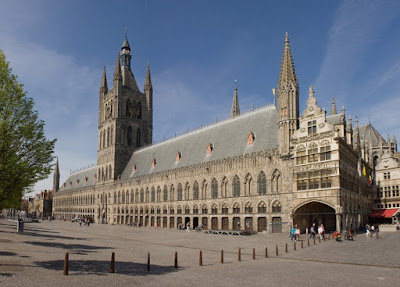
Bursary award to carry out research in Belgium (In Flanders Fields Museum).

I am delighted to announce that I have been selected as a recipient of a bursary to carry out research in Belgium. Organised in conjunction with the Embassy of Ireland in Brussels, I will travel to Ieper / Ypres and conduct research into Irish involvement in the First World War at the In Flanders Fields Museum. I will post more information about the project soon. I am grateful to the Irish Embassy and the Museum for selecting my application from the large number submitted.

https://blogger.googleusercontent.com/img/b/R29vZ2xl/AVvXsEjnZYcCWmKQGyezKsbYh33Ib7hUBw0EuCbHB3LcOWtr8xtvUp6myZtwwMi94WJqWzjIseoTAWr8hK_i0j56fn41H0TjQZgZ9wHHI4cIYtXRDj3owa_lq6lNyZxovy1Ju6oh1Qo5xRYA34vy/s1600/Ieper+Lakenhal.jpg 

In Flanders Fields Museum. Image source